
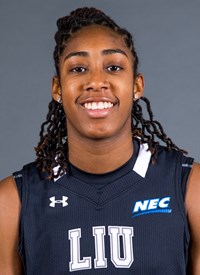
The Lee County (Florida) Athletic Conference inducted DeAngelique Waithe, ’18, into its 2021 Hall of Fame class. Waithe was a four-year letter winner for East Lee County High School where she led her team to a district runner-up. She was All-Area in 2014, capping off her 1,000-point career being named a finalist for Miss Basketball in Florida. At LIU, Waithe averaged 12.6 points and 8.7 rebounds per game in her senior season and went on to play professionally in Europe.
Expert Accountant Hired as Managing Director

Fiske & Company, one of South Florida’s oldest public accounting firms, announced the hiring of Staci Parrish, CPA, ’96, as managing director of tax and accounting. Parrish brings more than 30 years of experience in advising clients on a variety of taxation matters. Prior to joining Fiske & Company, Parrish worked for a number of national accounting firms, and she is an active member of several professional and volunteer organizations in her community.
Americans With Presidential Lineage Form ‘Society of Presidential Descendants’ to Create Educational Opportunities About U.S. Presidency
Tweed Roosevelt, Massee McKinley, Lynda Johnson Robb & Clifton Truman Daniel To Lead Initiative
A group of Americans with direct lineage to one or more of the 46 United States presidents announced today the formation of the Society of Presidential Descendants, which will reside at Long Island University. The organization will enable and support educational programs that focus on the history of the presidency and the importance of civic engagement in American democracy.
Educational initiatives will include the development of presidential curricula for schools, sponsorship of a biennial book award on presidential leadership, and presidential leadership conferences with presidential descendants as speakers. The Society will also sponsor a high school writing competition and work with museums around the country on presidential exhibits.
Tweed Roosevelt, the great-grandson of President Theodore Roosevelt, serves as president of the Society and has dedicated much of his professional life to upholding the legacy and preserving the history of his great-grandfather’s presidency. As a professor and chairman of the Theodore Roosevelt Institute at Long Island University, Tweed Roosevelt led the effort to form the society along with Massee McKinley, Lynda Johnson Robb and Clifton Truman Daniel, who serve as vice president and chief of staff, vice president and vice president, respectively. Society of Presidential Descendants members are direct descendants of a President of the United States.
“The Society of the Presidential Descendants was founded to promote the historical legacy of the presidency and those individuals that have held the highest elected office in our great country,” said Tweed Roosevelt, chairman of the Theodore Roosevelt Institute, university professor at LIU, and great-grandson of the former president. “Through family members with direct lineage to a U.S. President, the group seeks to bring further insight into the office of the presidency by offering educational events, programs, and seminars.”
“Led by Tweed Roosevelt, the Theodore Roosevelt Institute at Long Island University, serves as a home for research, public seminars, educational programs and conferences about Roosevelt, his times and contemporaries,” stated Long Island University President Kimberly R. Cline. “We are proud to further build on the study of presidential leadership by working closely with the Society of Presidential Descendants.”
Members of the Society of Presidential Descendants will participate in the Society’s inaugural presidential gathering in Long Island, New York, held June 10-12, 2022, with events planned at Long Island University and Theodore Roosevelt’s Sagamore Hill. The weekend will include a welcome dinner with fellow descendants, a public symposium with distinguished speakers, a private tour at Sagamore Hill, and a gala dinner where a prestigious honoree will be presented with the Society’s medal.
According to Massee McKinley, the great-great nephew of the 25th U.S. President William McKinley, and the great-great grandson of the 24th U.S. President Grover Cleveland, “The Society of Presidential Descendants holds tremendous promise in promoting the legacy of the United States presidency, its 46 unique leaders and the way these leaders are portrayed in studying their leadership styles. It is my sincere hope that the Society becomes the authority in educating America about each president, their leadership styles and how civics can play a vital role in this educational endeavor. I am encouraged about the future of America and its potential for leadership.”
Lynda Johnson Robb, the daughter of the 36th U.S. President Lyndon B. Johnson and his First Lady Lady Bird Johnson, commented, “In this time of polarization, I hope that this Society can encourage the study of our country’s history and how its Presidents have influenced it. We look forward to having an impact on the dialogue of what unites us as a country.”
Clifton Truman Daniel, grandson of the 33rd U.S. President Harry S. Truman and First Lady Bess Truman, concluded, “I hope that we can, in some small way, help the nation toward, if not unity, at least collegial and constructive disagreement. In the ranks of presidential descendants, historic friendship endures while political rancor fades away.”
Visit the societyofpresidentialdescendants.org website.
About Long Island University
Long Island University, founded in 1926, continues to redefine higher education, providing high quality academic instruction by world-class faculty. Recognized by Forbes for its emphasis on experiential learning and by the Brookings Institution for its “value added” to student outcomes, LIU offers over 250 degree programs, with a network of 270,000 alumni that includes industry leaders and entrepreneurs across the globe. Visit liu.edu for more information.
54% of Americans Believe the Worst of the Pandemic is Not Over as Demand for Vaccines Increases, Long Island University Hornstein Center National Poll Finds

BROOKVILLE, NY, February 11, 2021 – Results of a newly released Long Island University Steven S. Hornstein Center for Policy, Polling and Analysis national poll reveal that many Americans believe the worst of the pandemic is not over as demand for vaccines increases. Americans over age 60 with this belief were as high as 65%.
PDF Format – Includes sample and methodology detail
15% OF AMERICANS SAY THEY RECEIVED THE CORONAVIRUS VACCINE
Americans were asked if they received a coronavirus vaccine. 15% of respondents said yes.
74% OF AMERICANS WANT THE CORONAVIRUS VACCINE (UP FROM 71% IN DECEMBER 2020)
Americans were asked if they would agree to be vaccinated if an FDA approved coronavirus vaccine was available right now. Of the respondents, 74% said yes, which is tracking significantly higher from 38% in October 2020 and slightly higher than 71% in December 2020 through national polls conducted by Long Island University Steven S. Hornstein Center for Policy, Polling & Analysis.
77% OF AMERICANS OVER AGE 60 WANT TO BE VACCINATED IMMEDIATELY OR WITHIN THE MONTH
Americans over age 60 are most interested in the immediate availability of the coronavirus vaccine. 77% of Americans over age 60 said they would get the vaccine within a month of availability. CDC data indicate over 44 million vaccine doses have been administered to date in the United States.
DO YOU BELIEVE THE WORST OF THE CORONAVIRUS PANDEMIC IS OVER?
65% OF AMERICANS OVER AGE 60 SAY NO; 45% OF AMERICANS AGE 18 TO 29 SAY NO
Respondents were asked if they believed the worst of the pandemic was over. Overall, 54% of respondents said no. 65% of Americans over 60 years old said no. 56% of Americans aged 45-60 said no. 49% of Americans aged 30-44 said no. 45% of Americans age 18 to 29 said no. Older Americans were more concerned that the pandemic had not yet peaked than younger Americans.
78% OF AMERICANS REMAIN CONCERNED OVER RISK OF FAMILY CONTRACTING THE CORONAVIRUS
Americans were asked how concerned they were about someone in their family becoming seriously ill from the coronavirus. 78% of respondents said they are somewhat or seriously concerned. Respondents with the highest concern that they or someone in their family could become seriously ill from the coronavirus are Democrats (89%) followed by Independents/other (73%) and Republicans (68%). 80% of respondents over age 60 were also somewhat or very concerned over family risks from the coronavirus.
78% OF AMERICANS AGREE THAT WEARING MASKS IN PUBLIC REDUCES THE SPREAD OF CORONAVIRUS
While political differences remain in Americans’ belief that wearing a mask in public reduces the spread of the coronavirus, 78% of Americans agree that it does. When asked if wearing masks reduces the spread of coronavirus, 93% of Democrats said yes; 73% of Independents said yes; and 63% of Republicans said yes.
STATE VACCINATION PLANS AND CDC AUTHORIZED VACCINES
Each state health department has a tailored plan for vaccination rollout in the United States. Currently, the two vaccines that are authorized and recommended to prevent COVID-19 by the CDC are Pfizer-BioNTech COVID-19 vaccine and Moderna COVID-19 vaccine.
METHODOLOGY
This Long Island University Steven S. Hornstein Center for Policy, Polling, and Analysis online poll was conducted through SurveyMonkey from January 21 – 22, 2021 among a national sample of 1,622 adults ages 18 and up. Respondents for this survey were selected from over 2.5 million people who take surveys on the SurveyMonkey platform each day. Data for this week have been weighted for age and gender using the Census Bureau’s American Community Survey to reflect the demographic composition of the United States. The modeled error estimate for this survey is plus or minus 2.5 percentage points.
ABOUT THE LONG ISLAND UNIVERSITY STEVEN S. HORNSTEIN CENTER FOR POLICY, POLLING, AND ANALYSIS
The Long Island University Steven S. Hornstein Center for Policy, Polling, and Analysis conducts independent polling, empirical research, and analysis on a wide range of public issues. Our studies inform the public and policy makers about critical issues, attitudes, and trends shaping the world. Visit liu.edu/Hornstein for more information and results from this national poll.
ABOUT LONG ISLAND UNIVERSITY
Long Island University, founded in 1926, continues to redefine higher education, providing high quality academic instruction by world-class faculty. Recognized by Forbes for its emphasis on experiential learning and by the Brookings Institution for its “value added” to student outcomes, LIU offers over 250 degree programs, with a network of 270,000 alumni that includes industry leaders and entrepreneurs across the globe. Visit liu.edu for more information.
New CEO Appointed to Lead Queens Hospital
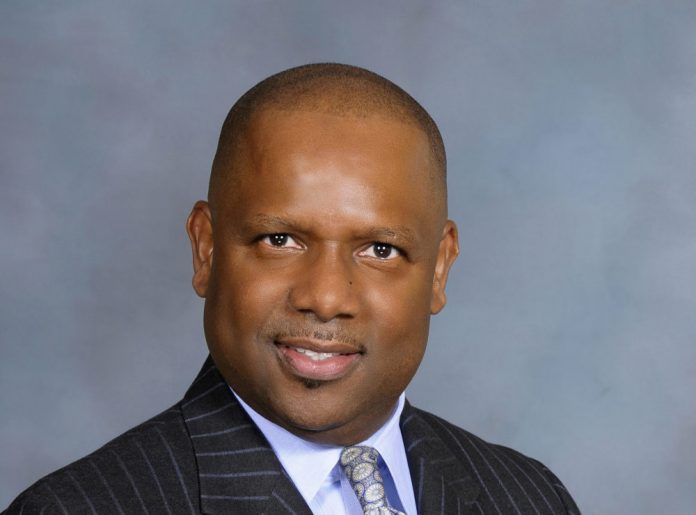
New York City Health + Hospitals announced that Neil J. Moore, ‘97, will become the new CEO of Queens Hospital in Jamaica, Queens effective February 15. Moore’s most recent position has been principal of LIEN Healthcare Solutions, and he previously served as president and CEO, executive vice president and chief financial officer of Dimensions Healthcare System. Moore is also dedicated to community service by sitting on numerous boards and advisory committees, speaking at national conferences, and mentoring numerous aspiring health care workers.
Experienced Accountant Named Partner at Global Firm

Mazars, a leading accounting, tax, and consulting firm, announced that Nissim Cohen, CPA, ’00, has joined as partner in the firm’s New Jersey manufacturing and distribution practice. Cohen will focus on providing value-adding tax services to clients of all sizes, ranging from large multinational corporations to privately-held businesses, including business owners. Prior to joining Mazars, he was a managing director in the business tax services group for the Big 4 firm Deloitte.
Renowned Banker Elected to Board of Directors
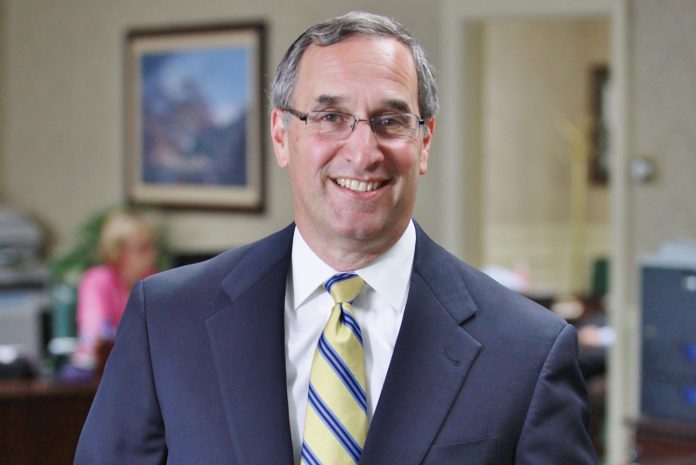
Peoples Bancorp Inc. announced that Michael N. Vittorio, ‘77, has been elected to the Peoples Board of Directors, and the Board of Directors of Peoples’ banking subsidiary, Peoples Bank. Vittorio is the former president and CEO of The First of Long Island Corporation and its banking subsidiary, The First National Bank of Long Island. He also served on the boards of directors of both entities until his retirement.
Basketball Star Named Conference Co-Player of the Week

The Northeast Conference named LIU men’s basketball junior Eral Penn as Co-Player of the Week after helping lead the Sharks to reclaim first place in the conference. Over the Sharks’ last three games, Penn is averaging 20.7 points, 11.3 rebounds, 2.5 assists, 1.7 blocks and 3.0 steals. He was also named Co-MVP of the annual Battle of Brooklyn rivalry game between LIU and St. Francis Brooklyn, which the Sharks won 102-88.
LIU Pharmacy Students Administer Vaccines on the Front Lines
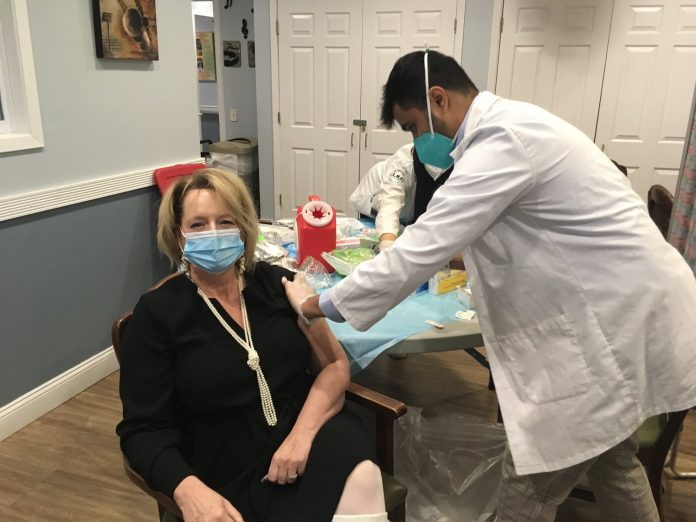
LIU Pharmacy students continue to serve on the front lines of the pandemic. A recent article in the LI Herald highlighted a LIU Pharmacy student who is interning at CVS Pharmacy and has administered the vaccine in nursing homes or long-term care facilities over the past month. Prior to administering the vaccine, LIU Pharmacy students attended continuing education workshops to learn more about the vaccine and how to answer questions from patients.
Sports Illustrated Features Longtime Nets Scorekeeper

Sports Illustrated published a profile of Herb Turetzky, ’68, ’73, who has served as the scorekeeper for the Brooklyn Nets for the past 54 years. Turetzky’s tenure with the franchise began when he was a student at LIU Brooklyn in 1967, and the team was then known as the New Jersey Americans. He has become a staple in the organization and befriended NBA legends like Julius Irving and Vince Carter, while curating his own personal Nets museum in his home.