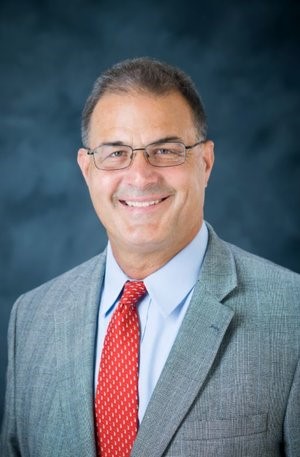
Dr. Richard Nader, Chief Research and International Officer at Long Island University, has been selected for a 2019-2020 Fulbright-Nehru U.S. International Education Administrators (IEA) award to India. This is his second Fulbright Award; his first was in 2014 to France. Dr. Nader heads the LIU Research and International Office (RIO), where his role includes strategic global research development and assisting faculty to enhance research and international activities.
This particular Fulbright program is a specially designed, short-term intensive program to connect U.S. universities to opportunities in India that match the interests and priority areas of LIU.
“I am thrilled and honored to be selected for this award and to represent LIU in highly recognized venues in India,” said Dr. Nader.
As Jeffrey L. Bleich, chair of the J. William Fulbright Foreign Scholarship Board, said in his recent acceptance letter to Dr. Nader, “The Fulbright Program, which aims to increase mutual understanding between the people of the United States and the people of other countries, is the flagship international exchange program sponsored by the U.S. government.”
Named after U.S. Senator J. William Fulbright, more than 380,000 Americans have participated in the program since its inception in 1946. As a grantee, Dr. Nader will join the ranks of 59 Nobel Laureates, 84 Pulitzer Prize winners, 72 MacArthur Fellows and 16 Presidential Medal of Freedom recipients.
“I think Fulbright said it best,” added Dr. Nader, “when he said: ‘The making of peace is a continuing process that must go on from day to day, from year to year, so long as our civilization shall last.’ ”
Dr. Nader has more than 30 years of experience in research and international affairs.
Before coming to LIU in June 2018, Dr. Nader served as Associate V.P. for International Development at Mississippi State University, where he led efforts in international development, education and research, including establishing the state’s first Fulbright Association. Previously, Dr. Nader worked at the National Science Foundation’s Office of International Science and Engineering and at Texas A&M University.
“Research and creative activities are noble pursuits,” Dr. Nader said. “A university values faculty because they carry out its goals: the pursuit of truth through discovery, and the pursuit of peace through freedom of expression, debate and understanding the human condition. Research, teaching and service are the key means of accomplishing the university’s goals, and for universities to thrive, they must excel at all three missions.”
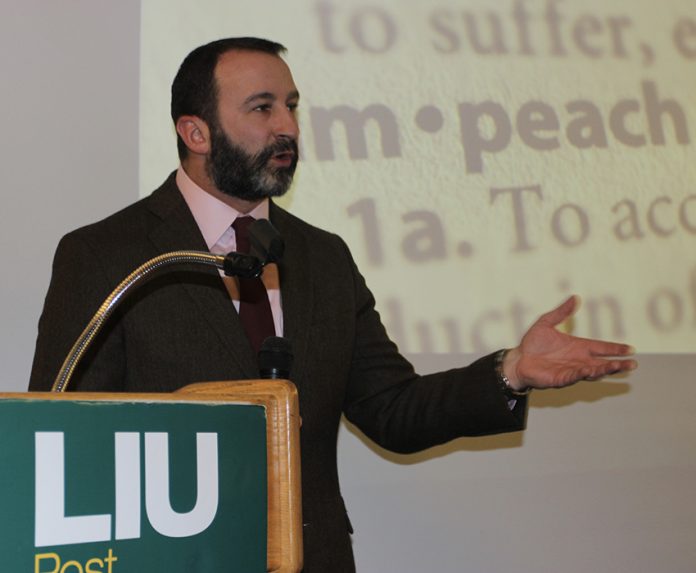
Constitutional historian James Coll tells his listeners at Hutton House how the founders gave Congress impeachment powers.
The topic couldn’t have been more timely as a crowd packed Lorber Hall on the LIU Post campus in mid-December to hear a Hutton House Lecture delivered by James Coll on the issue of impeachment.
Coll, a retired New York City Police Department detective, is an adjunct professor of American and Constitutional History at Nassau Community College and Hofstra University. For a decade he’s been a popular guest lecturer at Hutton House.
Before a very attentive audience, he began his talk with a disclaimer.
“No one in here wants to hear me spout on whether I think the president should be impeached or whether I think the president should not be impeached,” said Coll, with a smile. “And no one in here wants to hear whether you think that, either. We’re going to have a conversation about process. I don’t talk about outcomes.”
He told his listeners he also wouldn’t say whether the impeachments against President Andrew Johnson in 1868 and President Bill Clinton in December 1998—the only two American presidents so far to be impeached—were justified.
What he did do is make good on his promise to fully inform his class on how the U.S. Constitution came to embody the founders’ idea of holding our highest elected officials accountable without undermining the democratic process.
This vital question of not just how to put people in office but how to remove them arose early in June 1787 after the Constitutional Convention had barely begun its meeting in Philadelphia. By that time, five states’ constitutions already had impeachment clauses so these representatives had something to work with. Delaware’s John Dickinson proposed that the president could be removed by a majority of state legislatures voting in favor of it, but that idea was dropped.
Ultimately, the House of Representatives was given the power to impeach with a simple majority vote, and the Senate had the sole ability to convict and remove but only with a super majority—two-thirds of those Senators present. As Coll explained, during an impeachment, the House of Representatives acts like a grand jury, and the Senate performs like a jury in open court.
“The impeachment process is designed to be political,” Coll said, but he added that the founders definitely did not want a simple majority to be able to “undue an election.”
Coll explained that the Constitution specifically defines two impeachable offenses, bribery and treason, but what it means by the mention of “high crimes and misdemeanors” has been open to debate for over two hundred years.
“Ultimately, if it’s a president that the Congress opposes for any reason almost of their choosing, they have the ability to use those Constitutional clauses to their advantage,” Coll said.
For President Johnson, after the House voted to impeach him by a lop-sided vote of 146-30 in February 1868, the Senate conducted its trial in March. Coll noted that even though it was an election year, “they literally couldn’t even wait until November” to get rid of this man. But the votes to convict Johnson on those impeachment charges fell one short of the super majority. For President Clinton, the House tally to impeach him was closer, 221-212, but the Senate didn’t come close to having a super majority on either of the two impeachment charges against him, rejecting the first charge 55-45 (67 votes were the threshold), and the second 50-50. Ultimately, on Jan. 20, 2001, his last day in office, Clinton accepted a five-year suspension of his Arkansas law license and paid a $25,000 fine. No criminal charges were ever filed against him.
Getting to the impeachment issues embroiling the current occupant of the White House, Coll was more circumspect. He cited what the presumed incoming chairman of the House Judiciary Committee, Rep. Jerrold Nadler, a New York City Democrat, had warned about a process that could tear the country apart if a “good faction” of the American voters on both sides of the political aisle weren’t convinced that it had to be done.
“The model that Nadler is talking about, which I think is the model that the founders envisioned for impeachment,” Coll said, “is that it’s not a partisan endeavor.”
He noted that President Richard Nixon resigned rather than face impeachment, once it became clear that he’d lost the support of members of his own Republican Party—a stunning turnabout.
“In 1972, Richard Nixon and Spiro Agnew get more votes for the presidency and the vice presidency than any candidates running for those offices in the history of our country,” Coll recounted. “Within two years, both offices are occupied by two people who did not get a single vote for either of those offices.”
In conclusion, Coll said that the founders gave the House of Representatives a tremendous amount of power—and it comes with a tremendous amount of responsibility.
“If we’re talking about impeachment, it is literally whatever 218 members of the House say it is,” he explained, but he hoped “it is something that we do not use as a way just to overturn election results. Now we’ll see what happens going forward.”
When Coll finished, he was greeted with an ovation.
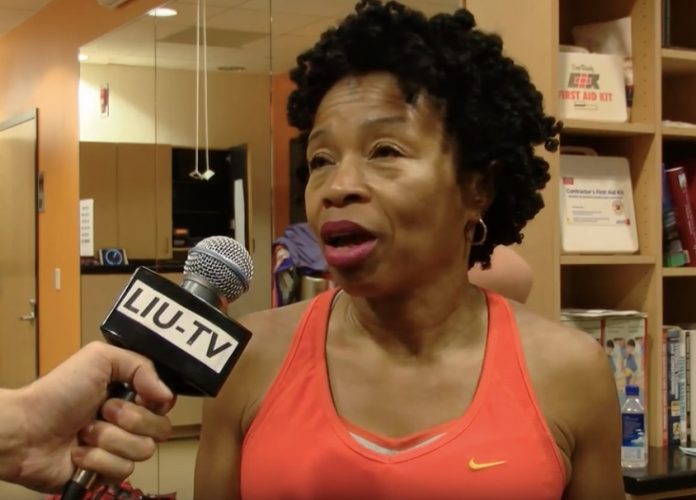
Janice Holt Mason, an adjunct instructor in the Department of Athletic Training, Health & Exercise Science at LIU Brooklyn, has been involved with the exercise class for people with Parkinson's disease since the fitness program began in 2008.
Parkinson’s disease (PD) is a progressive brain disease that causes a person to increasingly lose control of their movements and balance, and experience other difficulties. For more than a decade, LIU Brooklyn has been collaborating with the Brooklyn Parkinson’s Group to help individuals with Parkinson’s stay active through a free exercise program called Fitness for PD, directed by Dr. Rebecca A. States, professor of Physical Therapy.
“Anyone with Parkinson’s is encouraged to stay physically active and socially active,” said Dr. States. “This program helps them do that.”
Recently two LIU Brooklyn students, Savvy Williams and Chris Burgess, made a video of the program in action. Here’s the link.
“They were a pleasure to work with, very professional and with great skills,” said Professor States, who explained that the program’s goals are to help people find a way to live with Parkinson’s and enjoy their life.
Janice Holt Mason, a certified fitness instructor and an adjunct instructor in the Department of Athletic Training, Health and Exercise Science (ATHES) at LIU Brooklyn, has been teaching this class since it began in 2008 and seen it evolve.
“We saw that it would be a great benefit to the students and the school to turn it into a bonafide course,” she explained.
Dr. States praised Holt Mason’s “extraordinary ability” to tailor the exercises to fit the needs of each individual.
“Having a form of exercise that works for them helps them fight the disease,” added Dr. States.
Nancy Petaja, who heads the Brooklyn Parkinson’s Group, commended Fitness for PD.
“The program has made a huge contribution to the services we have available for people,” Petaja said.
The two-and-a-half-hour class meets on Tuesdays and Thursdays during the Fall, Spring and Summer semesters. On any given day, there are usually a dozen participants. All told 120 people have gone through the program, according to Prof. States, who added that two other ATHES faculty members, Amerigo Rossi and Tracye Rawls-Martin, also help run it.
At its recent 2018 annual conference held in Boston, the National Collegiate Honors Council paid its highest tribute to Dr. Joan Digby, director of the Honors College at LIU Post, by giving her the NCHC Founders Award: “the most prestigious award bestowed by our organization.”
Founded in 1966, NCHC currently boasts 900 member institutions and several hundred individual members, altogether impacting more than 330,000 honors students.
The Founders Award, which was created on the association’s 50thanniversary, “serves to honor members who have been instrumental in the development and advancement of NCHC and its programs.”
Digby fits that description perfectly.
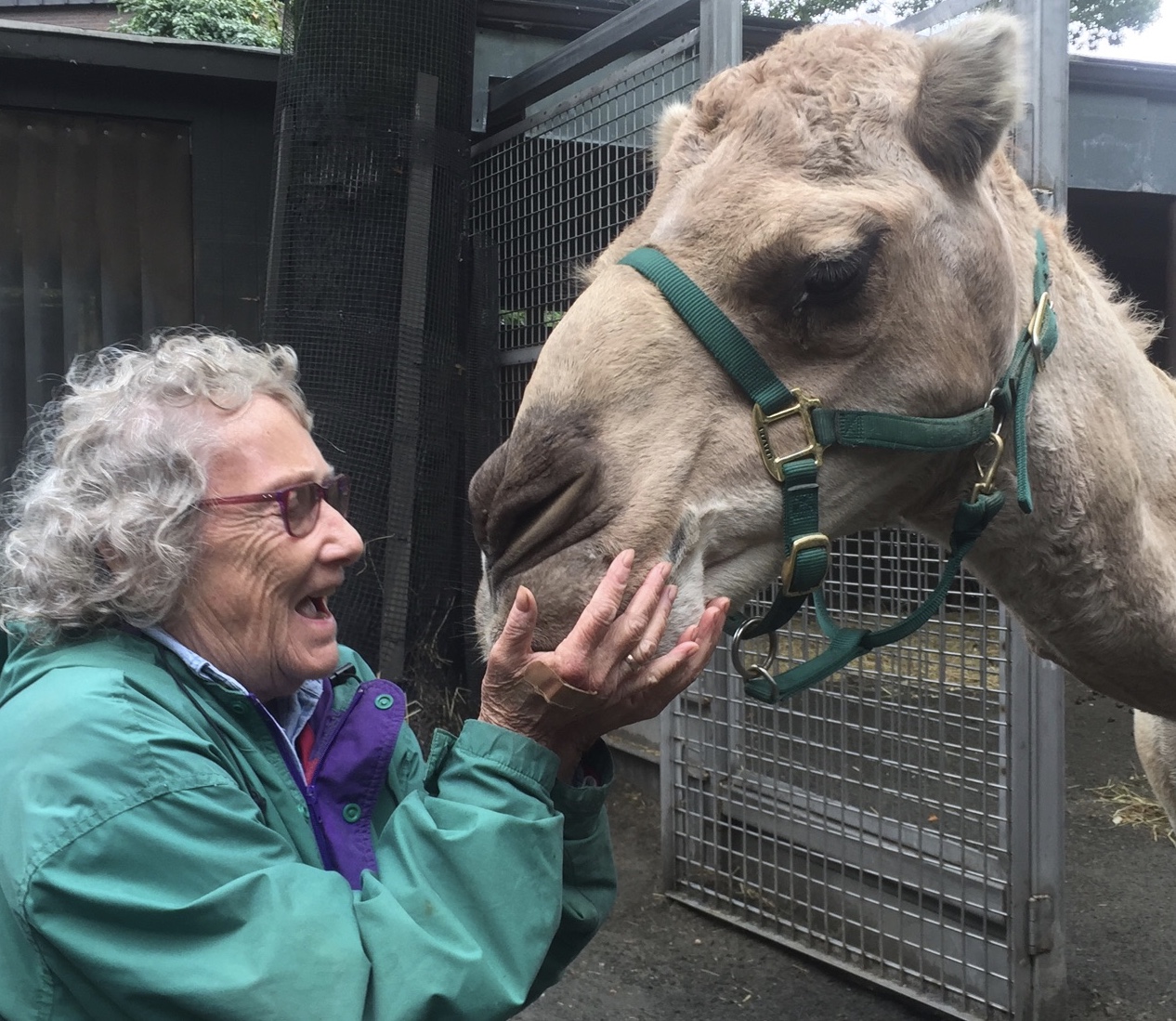
“If honors education in some sense celebrates a Renaissance vision of humankind, Joan Digby is that image incarnate,” said Dr. Jeff Portnoy, co-chair of the NCHC Publications Board and editor of the NCHC Monograph Series, at the presentation ceremony. “She is a scholar, an essayist, an editor, a poet, an adventurer in nature, a protector of wild camels, a woman of the horse, a publisher, a film producer, a provider of food and lodging for generations of cats, and a Founder of initiatives central to the heart of honors education and NCHC.”
Dr. Digby has been at LIU Post since 1969 after she received her Ph.D. in English from New York University, where she did an award-winning dissertation on 18thcentury fabulists and had previously gotten her undergraduate degree. She earned her Master’s at the University of Delaware.
The honors program at Post had gone through three directors when Digby was asked in 1977 if she wanted to take it over. She readily agreed—and has been running it ever since. According to the National Collegiate Honors Council, the average duration of an honors director is three years.
“I have fun,” Digby declared. “I never get bored. I really have a ball with it.”
Over the years, she has been the president of the national organization as well as of the Northeast Region. She’s served on numerous NCHC committees as well as its publications board. She took the initiative and with her assistant, Tracey Christy, compiled “Peterson’s Guide to Honors Programs & Colleges,” which NCHC called “a mammoth undertaking [that] chronicled the resources of honors operations, attributes, and offerings at colleges and universities across the country.”
With Heather Thiessen-Reilly, Digby co-edited “Partners in the Parks: Field Guide to an Experiential Program in the National Parks,” now in its second edition, which grew out of a unique collaboration between NCHC and the National Park Service. Digby’s inspiration for the partnership program had come after she had visited Rocky Mountain National Park, a breathtaking 415-square-mile expanse in Estes Park, Colorado, following an NCHC conference in Denver.
While gazing at that magnificent panorama, Digby had an epiphany.
“I started to think that Long Island students do not move off this square,” she recalled. Back in the classroom she asked her students how many had been to a National Park? A few had been to Sagamore Hill in Oyster Bay, the home of President Theodore Roosevelt, and some students had been to the Statue of Liberty, but almost none had ventured to a National Park west of the Mississippi. Digby came up with a two-page proposal.
“I wrote it knowing that I have no idea how to go camping!” she laughed. “I’m from the Bronx—what do I know?” She emailed her proposal to NCHC’s members and within minutes she said—snapping her fingers to emphasize the speedy response—two professors in the honors program at Southern Utah University replied. “They said, ‘We’ve always dreamed of doing this.’ I said, ‘Go run with it!’” And so the innovative program was born.
Since then, Digby has accompanied honors college students to Utah’s Bryce Canyon, Alaska’s Denali National Park and Preserve, Maine’s Acadia National Park and Virgin Islands National Park on St. John. Nearer to our shores, she’s gone to Fire Island National Seashore and Ellis Island.
“They are really life-changing trips,” she said. All told, the program now has more than 1,5000 alumni.
Partners in the Parks epitomizes Digby’s belief that an honors program should get college students to do undergraduate academic research and write a thesis as well as obtain some “experiential learning out in the world—not just sitting in the classroom.”
What she won’t do, she said, is do “honors by contract, meaning that you take any class but it you do an extra this or an extra that, you get honors credit,” Digby explained. “I’ve done it a few times out of necessity, but it’s not my idea of what honors should be.
“For me,” she continued, “all my classes are little seminars—that’s how I’ve structured it. The students are never in a lecture situation. They’re really talking with each other and communicating as a group and doing things in a group—and that makes a big difference, too.”
As she envisions it, having students meet in an honors class together helps them form a cohort that may long outlast their graduation. Recently two students Digby hadn’t seen in over 30 years each came to tell her how much she’d motivated them in their subsequent careers.
“I try to push them wherever they’re going,” she said, referring to the honors students she’s seen come and go.
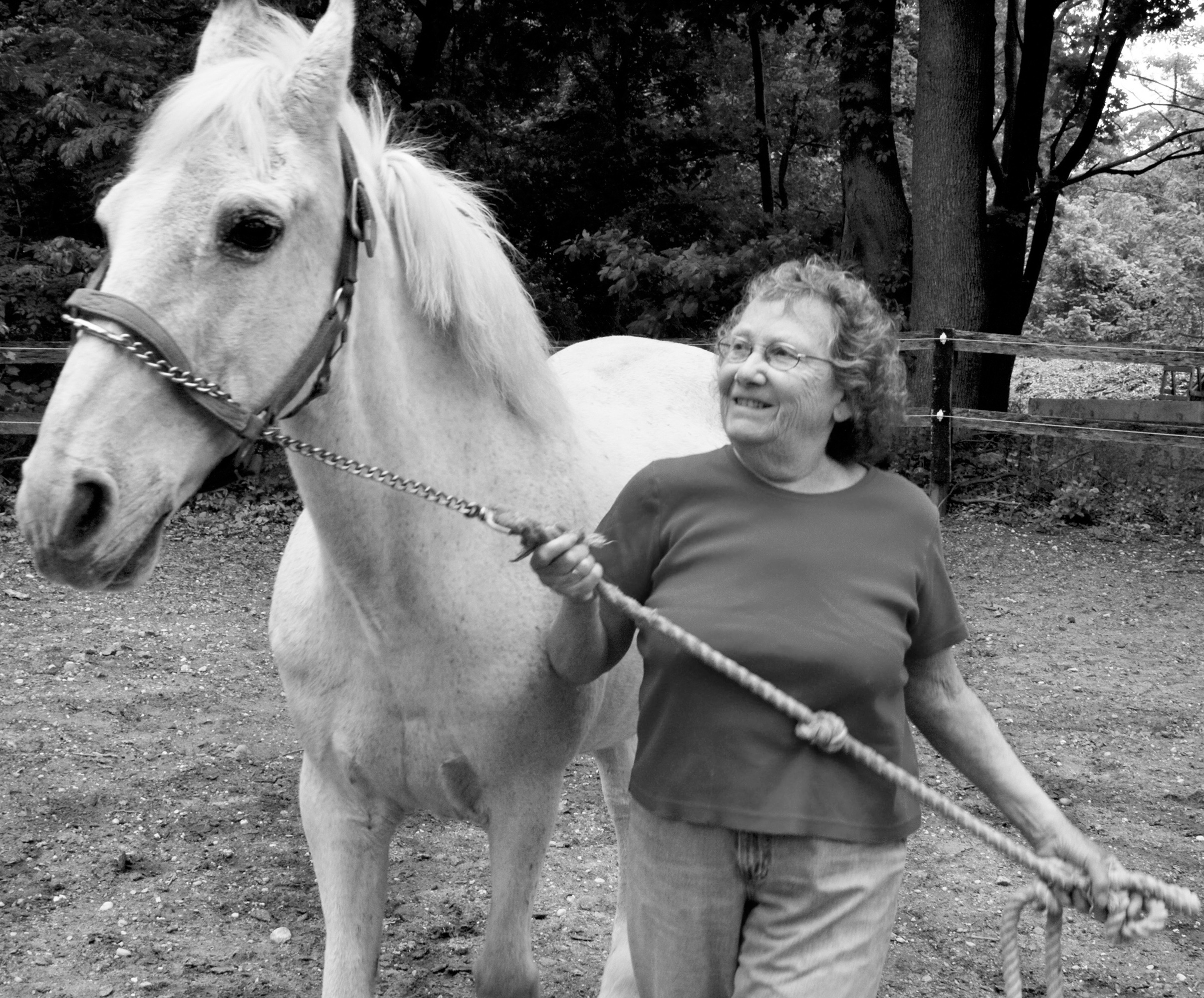
Along the unconventional path she’s taken, Digby has befriended many feral cat colonies on the Post campus as well as taking the horses at the nearby Northshore Equestrian Center under her wing. In 2005, with her collage-artist husband, John Digby, she founded The Feral Press, which has published more than 250 limited-edition books. Last year, on her sabbatical, she wrote three volumes of poetry, including one with her favorite equine collaborator, Snowball. When she turned 50, she learned to ride horseback on him despite his cantankerous reputation.
Taking Snowball for a walk at the Northshore Equestrian Center [Photo by Joan Harrison]“He was known as a sour horse,” she admitted. “Even now, he’s not a really friendly horse…Snowball doesn’t think. Snowball eats, tries to bite me, and goes for a walk—I love him!”
About 20 years ago, Digby recounted, “I decided that if I could pay particular attention to him, I could soften his temperament and make him bite people less frequently.”
These days, it’s become a moot issue since Snowball has lost all his teeth. Nonetheless, their partnership has been quite productive. “I’ve written poems about him for years,” she said with a smile.
Although she no longer rides on horseback, Dr. Joan Digby knows she has many more inspirations still to come.
[Photo of Dr. Digby with a camel was taken by Ruth Iannuzzi.]
Under the leadership of industry expert Cherie Serota, LIU Post’s Fashion Merchandising program is looking glamorous these days.
New York City is the fashion capital of the world. LIU Post’s School of Business is approaching 20 consecutive years on The Princeton Review’s annual list of best business schools. Conjoining those two assets was the logic that fueled the University’s decision to launch a Fashion Merchandising program in 2015.
It should not then come as a surprise to see the program en vogue just three years later. With field trips abroad to fashion capitals in Europe, internationally-renowned guest speakers, industry-leading adjunct professors, frequent visits to Manhattan, a student-run boutique on campus, and much more, the excitement and pace are a perfect fit for such an ambitious degree.
As part of the College of Management, the B.S. in Fashion Merchandising teaches students business fundamentals and entrepreneurship, while fostering creativity in marketing and branding, with each class tailored to instruct industry-specific minutiae.
“We’re educating students on a broad spectrum,” Director Cherie Serota said. “They can go out and start their own businesses or they could work for a big company and be well versed in all the business aspects expected of them in today’s fast-paced, global fashion industry.”
The faculty lineup is star studded from the top to bottom, with vision casting from Serota and College of Management Dean Robert Valli, both of whom are prominent authors, and classes taught by industry professionals like Margaret Nicklas, a branding executive at Nine West Group, and Caryn Hirshleifer, one of the owners of luxury retailer Hirshleifer’s.
Those are just a few of the experts that students interact with on a weekly basis. Each semester they also rub elbows with some of the world’s biggest fashion icons beginning with events and shows at New York Fashion Week in September, visits to Women’s Wear Daily (WWD), The Doneger Group, and to meet prominent fashion designers at the New York City headquarters in between, capped off by an annual trip abroad.
During last year’s trip to Paris, Pamela Golbin, chief curator of fashion and textiles at the Musée des Arts Décoratifs at the Louvre, met with students and signed copies of her popular book Couture Confessions.
“It’s important to be in touch with global fashion scene,” Serota said.
Behind-the-scenes access to runway shows, garment centers, and museum exhibits, provide invaluable exposure and networking opportunities for students.
“They get to feel and sense the fast pace of the industry,” Serota said. “It’s great for them to see what goes into a line from concept to completion.”
When students aren’t soaking up expert knowledge, they are working with real products. The Student Body, one of LIU Post’s student-run businesses, is a boutique offering designer clothing. In addition to picking out the clothing and working the floor, the program utilizes the boutique to teach students how to craft a business plan, with detailed strategies for social media, marketing, and branding. The program also boasts 25 top-of-the-line Pucci mannequins, donated by Saks Fifth Avenue in Huntington last December, along with 50 high-fashion vintage couture gowns from top designers, such as Jacques Fath, Ungaro and Yves St Laurent as part of its fashion archive. Over the summer, students conducted a runway fashion show in Hillwood Commons for an enthused audience of more than 200 during LIU’s annual Summer Honors Institute (SHI).
The senior capstone project requires students create a fashion start-up, beginning with the inception of an idea all the way to the launch of a product, crafting a logo and exhaustive business plan in the process.
“It’s amazing to see everything they learned in their four years here, before going out and doing it on their own,” Serota said.
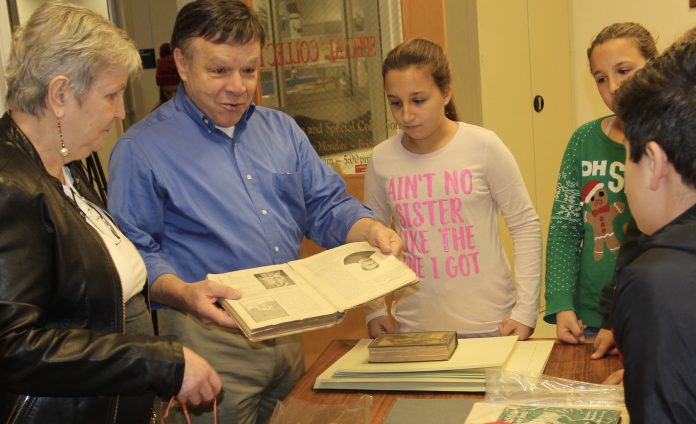
As Special Collections' acting director Jarron Jewell looks on, Paul Belard shares his skills with the Book Doctors from Norwood Elementary School in Northport.
LIU Post’s Archives and Special Collections hosted a unique class of students from the Norwood Elementary School in Northport, N.Y., who are called The Book Doctors because they want to learn how to take care of their library books.
As shown on Fios1 News, almost a dozen fifth-graders came to the Archives and Special Collections room on the third floor of the B. Davis Schwartz Memorial Library at LIU Post to learn firsthand from the master book repairer/book binder Paul Belard, who’s been a long-time friend of the University’s Special Collections. An engineer by training and a self-taught bookbinder who studied in France, his native country, Belard is the owner of New York Book Repair.
Also on hand for the morning session were Meghan Fitzsimmons, the new librarian at Norwood Elementary School; her predecessor, Linda Dickman, a co-teacher of “The Book Doctors”; and Jarron Jewell, acting director of LIU Post’s Archives and Special Collections and also the curator of the American Juvenile Collection, which is housed at the University.
Asked by Fios1 reporter Briella Tomassetti what he enjoys about being a Book Doctor, August Gesell, a 10-year-old student at Norwood Elementary School, replied, “My favorite part about doing this is knowing that people who have books are going to feel nice and warm inside when they get their books back.”
Fifth-grader Lily Forman described the process. “Books that are really old can take a couple of weeks to do because you have to glue back the pages [and] you have to fix the spine,” she explained. One benefit from being among the Book Doctors, she said, is that she can fix books with her friends.
Master book-binder and repairer Paul Belard, who volunteers his time with the Book Doctors, told Fios why he does what he does.
“It’s a way to pass my craft along,” he said wistfully, with a handful of students huddled behind him. “I don’t know, probably maybe one or two will keep on and go in this direction because there aren’t too many of us left now!”
School librarian Linda Dickman, who recently retired from Norwood Avenue Elementary, was instrumental in bringing Belard on board to share his skills. “In this current age of technology children are being encouraged to make things again. And what they’re doing is learning to make an old thing new.”
Dickman explained that the Book Doctors began about six years ago when a group of second graders approached her and said, “We’re going to start a club and you can join—or not!” So, she arranged for Belard to visit and he’s been a regular advisor ever since.
As part of the morning’s presentation, the students saw a first edition of Mark Twain’s “Huckleberry Finn,” which was printed in 1885, and got to examine the Special Collection’s copy of “The Book of Kells,” which Dickman dubbed “the rock star of books!” Originally created by a group of Irish monks in the year 800, this special reprint was published in 1990 by a Swiss firm specializing in the reproduction of medieval manuscripts.
Jewell also outlined the steps to take in the proper handling of vintage books with Belard weighing in. The Book Doctors do most of their work at the library before school starts. The kids were avid listeners and eager questioners. Their enthusiasm impressed their new librarian, Meghan Fitzsimmons, who said, “It’s really fun. It’s nice to see that all the kids are really interested in preserving books in the world of technology today.”
Whether they intend to follow in his footsteps and learn his craft or not, the students gave Belard a warm hug as they bid him farewell and boarded their bus to return to their school in time for lunch.
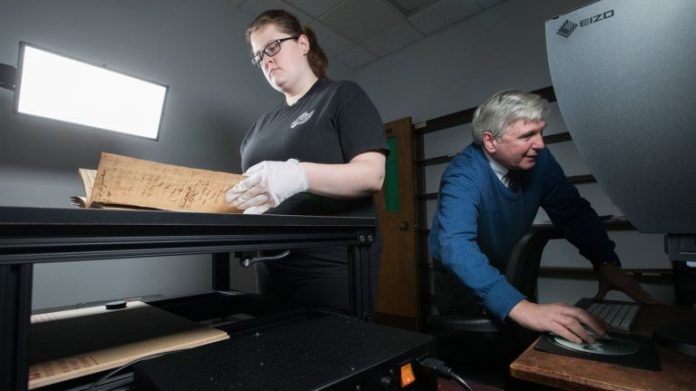
Dr. Gregory Hunter and one of his Palmer School graduate students, Wendy Ambrozewicz, prepare to scan a fragile document using the DT Atom digitization device at LIU Post.
Long Island University is pleased to announce that the Board of Directors of the Robert David Lion Gardiner Foundation has approved a grant in the amount of $695,000 to fund the Robert Moses Archival Project in partnership with the New York State Department of Parks and the New York State Archives. The program will be overseen by the Palmer School of Library and Information Science at LIU, which has been dedicated to the digitization and preservation of Long Island’s irreplaceable historical records.
“From Huntington to the Hamptons, from Fire Island to Gardiners Island, the history of Long Island is rich and varied,” said Dr. Kimberly R. Cline, president of Long Island University. “By working to preserve Robert Moses’s archival heritage, we’re bringing another part of that history to life.”
Thanks to the Foundation’s previous generous support of a separate project, “Digitizing Local History Sources,” the Palmer School is completing its second year of a six-year project to digitize materials found in Long Island’s local historical societies. So far, more than 25,000 images have been captured and over 5 terabytes of data have been accumulated from the collections of more than two dozen historical societies in Nassau and Suffolk Counties.
Both projects are directed by Dr. Gregory S. Hunter, who has helped the Palmer School at LIU become a national leader in library and information science. Dr. Hunter was part of the team that built the Electronic Records Archives for the National Archives and Records Administration in Washington, D.C. At LIU, Dr. Hunter serves as the director of the Palmer School’s Certificate of Advanced Study in Archives and Records Management.
“The influence of Robert Moses on New York State is unparalleled,” said Kathryn Curran, executive director of the Robert David Lion Gardiner Foundation, in a statement. “Access to his archives will offer researchers new insight not only to the man, but to the social, political, economic and cultural influences surrounding his massive projects. We at the Robert David Lion Gardiner Foundation are carrying on the vision begun by Robert David Lion Gardiner in supporting organizations making a significant contribution to understanding our communities and their history and legacy.”
Brian X. Foley, deputy regional director, Long Island State Parks Region, said this grant award was wonderful news and he looked forward to working closely with LIU on this project.
“One of the more distinguishing features of this effort lies in the fact that three major entities are working together to move this project forward: New York State government, Long Island University, and a dynamic Foundation, whose mission is to deepen our appreciation for New York State history,” said Foley in a statement. “The Robert Moses digitization project aligns perfectly with Gov. Andrew Cuomo’s ‘Path Through History’ initiative. One can rightly characterize it as a digital path through history.”
“We look forward to working with the project team and facilitating access to these great materials,”said Thomas Ruller, New York State Archivist.
Among Robert Moses’s many titles, he was president of the L.I. Parks Commission and chairman of the State Parks Council. Moses, the master builder chronicled in Robert Caro’s Pulitzer-Prize-winning biography, The Power Broker, did more than anyone in the Empire State to shape Long Island’s parks and recreation, bridges and highways, and so much more that New Yorkers take for granted today.
The Robert Moses Archival Collection, currently housed in three locations—two on Long Island and one upstate—is a huge and mostly intact collection of photographs, letters and architectural drawings. Now, thanks to the Gardiner Foundation’s new grant to the Palmer School at LIU, this remarkable legacy—once it’s completely digitized—will be preserved for posterity and available for future researchers through the Website of the New York State Archives.
Based in Hampton Bays, the Robert David Lion Gardiner Foundation, which was established in 1987 to support the study of New York State history, has given more than $2 million to LIU so Dr. Hunter, who also serves as director of the Palmer School’s Certifitcate of Advanced Study in Archvies and Records Management, could establish a graduate student cohort of Gardiner Foundation fellows who earn tuition remission for each semester they participate in the “Digitizing Local History Sources” project. With their generous support, he was able to purchase a state-of-the-art digitization system, the DT Atom, which can handle a wide range of archival materials from centuries-old deeds to a ceremonial ribbon distributed at President Abraham Lincoln’s funeral.
And now, Dr. Hunter will be able to deploy his students to preserving the important legacy of Robert Moses, who has left a lasting impact on Long Island.
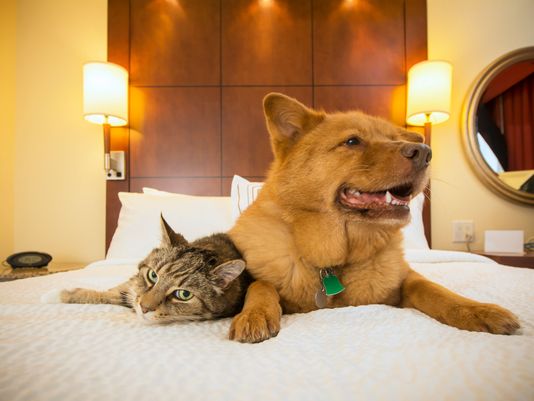
William J. McGee, an award-winning investigative journalist and travel editor, will be presenting “Aviation Series: Come Fly With Me” at LIU Post’s Hutton House Lectures for four weeks starting Jan. 30, 2019. The author of “Attention All Passengers,” McGee just published an article in USA Todayon traveling with pets over the holidays.
He notes that for many people, pets are treated like family members—and their owners wouldn’t want to exclude them from any special occasion.
But, he warns, taking animals on board a flight comes with its own set of issues.
“As a general rule, service animals and emotional support animals are welcome on most forms of public transportation, including the 10 largest domestic scheduled airlines,” he writes. “The most important advice, for all modes of travel, is to check with your veterinarian before planning any trips.”
McGee cites the American Society for the Prevention of Cruelty to Animals’ advice which states: “Unless your furry friend is small enough to ride under your seat, it’s best to avoid air travel.” People for the Ethical Treatment of Animals, McGee adds, “strongly advice against transporting your animal companion by air in the cargo area.”
In his USA Today article, which ran on Dec. 13, McGee also discusses taking pets by car, rail, buses and boats as well as finding the right hotel for the family’s four-legged friends.
William McGee, an FAA-licensed aircraft dispatcher, is a contributing editor to Consumer Reports and former editor of Consumer Reports Travel Letter. His Hutton House Lectures run in four weekly sessions, each starting at 10:30 a.m., from January 30 to February 20.
For more information on LIU Post’s Hutton House Lectures, which are usually held at Lorber Hall on the Post campus, call 516-299-2580 or email: TheLIUSchoolofProfStudies@liu.edu.
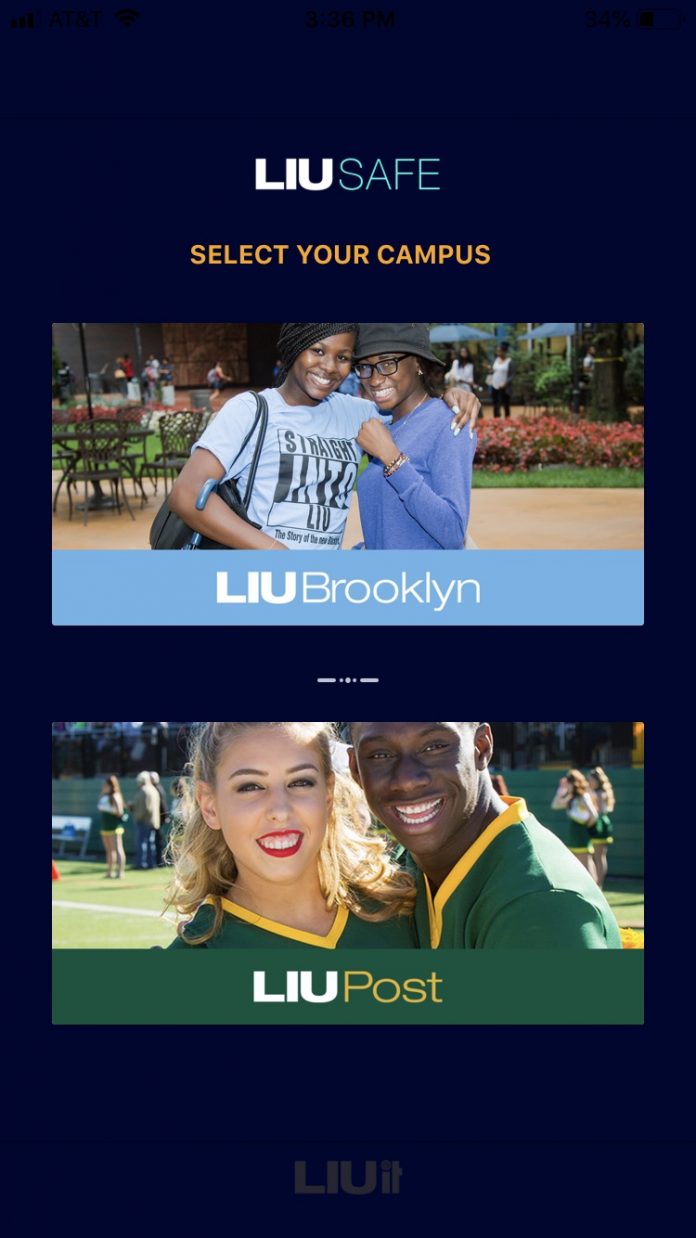
A new smartphone app called LIUSAFE will help students, faculty and staff at Long Island University to be ready to handle any emergency.
“This new app is free,” said Michael Fevola, the University’s Director of Public Safety. “We recommend you download it to your cell phone so you can be better prepared for any situation.”
The new app, which can be accessed through a cell phone’s app store, is supported by iOS and Android. For the iPhone link, go here; for Android, go here. It is also embedded in the LIU Mobile app. Once LIUSAFE is downloaded, it’s always available on your cell phone regardless of wi-fi service.
Whether it’s a bomb threat or a gas leak, a hazardous material spill or an active shooter condition, the new app puts the proper response right at your fingertips.
“It educates our community about what they can do in the event of an emergency,” said Fevola. “What I love about this is that it doesn’t just teach people what to do when they’re on campus, it also informs their everyday life.”
In particular, he recommends that people click on the “Run Hide Fight” icon on the LIUSAFE app and watch an 8-minute video on how best to survive this emergency before law enforcement arrives.
Here’s an important reminder: The Public Safety Department serves the Brooklyn and Post campuses 24 hours a day, 7 days a week, all year-round.
To contact public safety officers at LIU Brooklyn, you can pick up an on-campus phone and dial ext. 1078; if you’re off campus, use 718-488-1078. At LIU Post, if you’re using an on-campus phone, dial ext. 2222; if you’re off-campus, call 516-299-2222. Of course, calling 911 is always an option.
In the meantime, every student should register their cell phones with the LIU Post Emergency Alert System through the MY LIU portal.
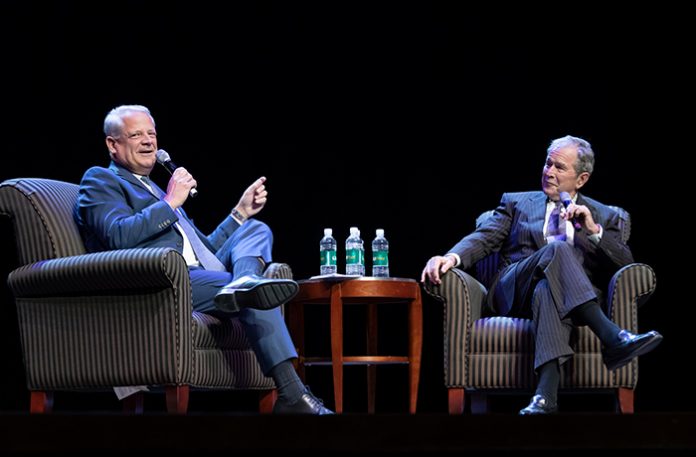
LIU Global Institute Chairman Steve Israel makes a point with President George W. Bush at the Tilles Center.
Former Congressman Steve Israel, now chairman of the Global Institute at LIU, drew upon President George W. Bush’s recent appearance at the Tilles Center at LIU Post to opine about his relationship with his father in an article that was just published in The Hill, an influential political newspaper and website based in Washington, D.C., which gets its name from Capitol Hill.
“On a stage at Long Island University earlier this fall, I asked President George W. Bush if he remembered any profound moments between him and his father during his presidency,” Israel wrote in an article headlined “A Father and Son Unite the Nation.”
“He did not have to think long,” added Israel.
The 43rd president recounted his experience at the Washington National Cathedral for a memorial service held for the victims of the 9/11 attacks three days after the tragedy. After delivering his remarks, Bush took his seat and, Israel wrote, “he felt a hand reach across to hold his. It was his dad. It was the reassuring grasp of a father with a son who bore the weight of a new world on his shoulders.”
Adding to the poignancy of the Dec. 5th op-ed, Israel observed that Bush’s father, the 41st president of the United States, would lie in state in that same cathedral for the national funeral service held that very Wednesday. Israel used the sad occasion to compare presidential styles, adding that “we do not simply mourn a president. We mourn the slow passing of a type of presidency. That was when humility was a virtue, not a character flaw. It was when the presidency was an institution whose occupant was a trustee, in every sense of the word.”
In his piece, Israel observed, “Most, but not all, adhered to the vital notion that the White House is an institution more important than the person who occupied it.”
Israel recalled that when President George W. Bush had appeared on stage at Tilles Center less than two weeks before the mid-term elections, he asked the 43rdpresident if he’d ever sought his father’s advice. “If I had,” Bush replied, “he would have told me to send my briefers to him in Houston or Maine. Then he would give me advice.”
Israel described that response as “quaint” compared to the behavior of the present occupant. As the former Long Island Congressman described that bygone era: “In the White House, listening to those in front of you is preferable to browbeating others for attention. As the president, receiving private unvarnished counsel is better than the public waving of pink slips. The highest office in the land deserves this kind of respect.”
Our presidents, Israel also wanted to remind his readers, are “fathers and sons, sometimes clasping hands in dark moments.”
As chairman of the Global Institute at LIU, Israel is doing his part to shed more light when the nation needs it most.



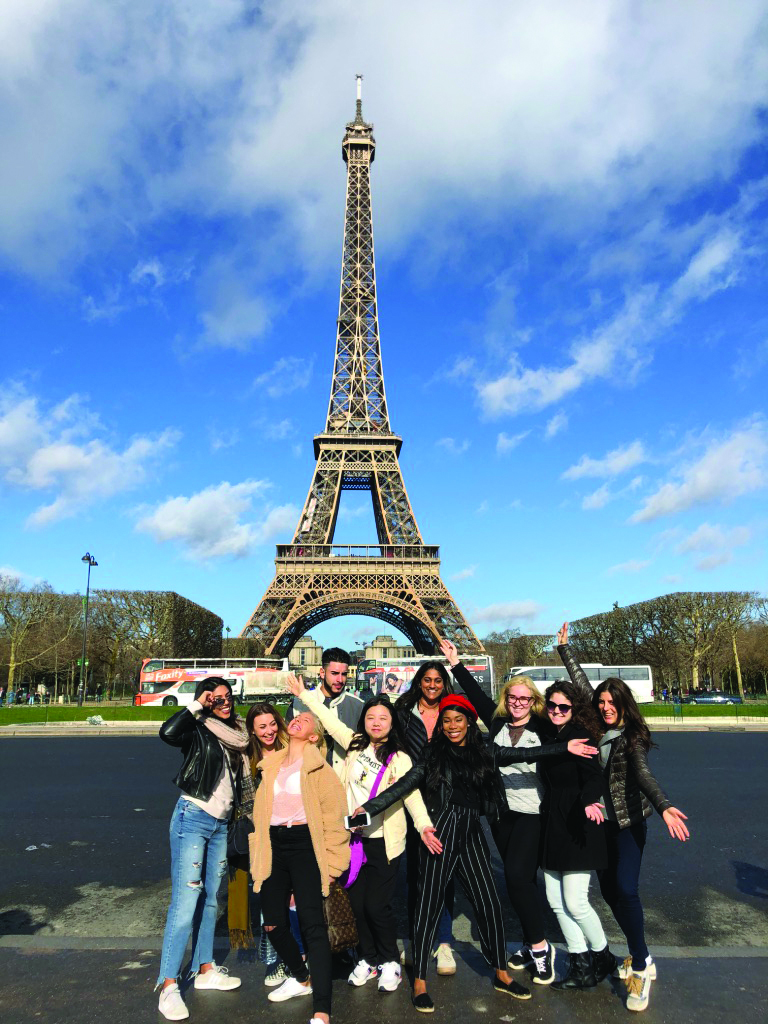 It should not then come as a surprise to see the program en vogue just three years later. With field trips abroad to fashion capitals in Europe, internationally-renowned guest speakers, industry-leading adjunct professors, frequent visits to Manhattan, a student-run boutique on campus, and much more, the excitement and pace are a perfect fit for such an ambitious degree.
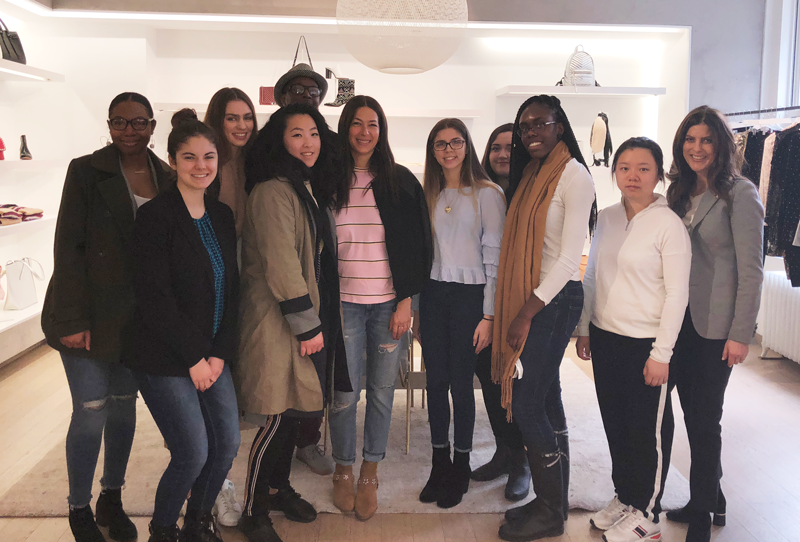 The faculty lineup is star studded from the top to bottom, with vision casting from Serota and College of Management Dean Robert Valli, both of whom are prominent authors, and classes taught by industry professionals like Margaret Nicklas, a branding executive at Nine West Group, and Caryn Hirshleifer, one of the owners of luxury retailer Hirshleifer’s.
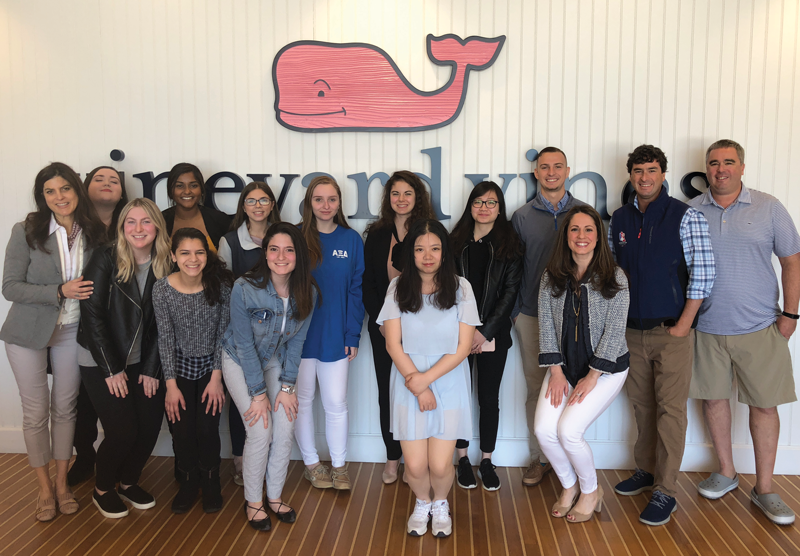 When students aren’t soaking up expert knowledge, they are working with real products. The Student Body, one of LIU Post’s student-run businesses, is a boutique offering designer clothing. In addition to picking out the clothing and working the floor, the program utilizes the boutique to teach students how to craft a business plan, with detailed strategies for social media, marketing, and branding. The program also boasts 25 top-of-the-line Pucci mannequins, donated by Saks Fifth Avenue in Huntington last December, along with 50 high-fashion vintage couture gowns from top designers, such as Jacques Fath, Ungaro and Yves St Laurent as part of its fashion archive. Over the summer, students conducted a runway fashion show in Hillwood Commons for an enthused audience of more than 200 during LIU’s annual Summer Honors Institute (SHI).