Home Blog Page 135

LIU Palmer School Hosts Gardiner Foundation Symposium to Honor History Project’s First Year

By using state-of-the-art digitizing equipment, more than 20,000 images from Long Island’s historical societies are now preserved forever.

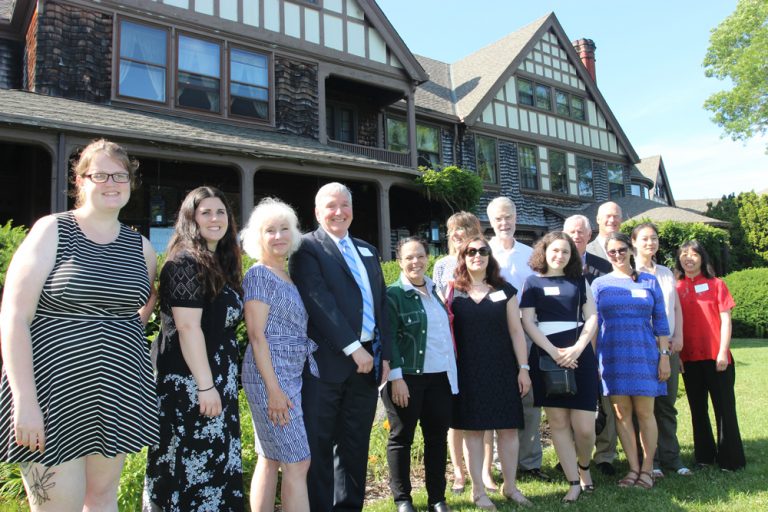
LIU’s Palmer School of Library and Information Science couldn’t have asked for a more perfect summer afternoon to kick off the inaugural Gardiner Foundation Symposium held at the historic Bayard Cutting Arboretum estate, with a gentle breeze blowing off the Connetquot River on Long Island’s South Shore.

The event, held on June 26 at the 600-plus-acre New York State Park in Suffolk County, celebrated the first year of the Digitizing Local History Project, an ambitious archival program funded with a $1.5 million grant from the Robert David Lion Gardiner Foundation and administered by the Palmer School at LIU Post. Gathered at the Upper Carriage House on the arboretum’s spacious grounds in Great River were foundation board members; students, faculty, and staff; as well as representatives from many of Long Island’s historical societies and public libraries.

“From Huntington to the Hamptons, from Fire Island to Gardiners Island, the history of Long Island is rich and varied,” said Dr. Kimberly R. Cline, President of Long Island University, as she welcomed the invited guests. “Through the Digitizing Local History Project we are now bringing that history to life.”

Dr. Cline singled out the vision of Kathryn M. Curran, the Gardiner Foundation’s executive director, for helping to make sure that “so many treasures that might have been lost will be preserved for future generations.” And she also praised the project’s director, Dr. Gregory S. Hunter, a nationally renowned archivist, who has helped the Palmer School become “a national leader in library and information science.” Dr. Hunter was part of the team that built the Electronic Records Archives for the National Archives and Records Administration in Washington, DC.

“We’re lucky to have him,” said Dr. Cline.

“Mother Nature has been very kind to us today,” observed Dr. Hunter, smiling broadly. He serves as the director at the Palmer School of Library and Information Science’s Ph.D. in Information Studies and the Certificate of Advanced Study in Archives and Records Management. The digitization project’s goals, he explained, are to safeguard Long Island’s historical materials, increase access to the materials, and give Palmer School students the necessary technical skills for their professional careers.

Thanks to the grant, Dr. Hunter was able to set up a graduate student class of Gardiner Foundation fellows.  Master’s and Ph.D. students receive six credits of tuition remission for each semester they participate in the project. Dr. Hunter was also able to purchase the DT Atom, a state-of-the-art digitization system that can be adapted to handle a wide range of materials. “I’ve yet to see a better scanner on Long Island,” he said.

When the program started in the fall semester of 2017, there were six master’s students, two doctoral students and two faculty members, including himself and Information Studies Professor Dr. David Jank. Students worked on-campus and in the field. Since its inception, the program has now captured more than 20,000 images and accumulated 4 terabytes of data from the collections of about a dozen historical societies. And they’ve only just begun.

Dr. Hunter outlined the scope of the project, currently funded through 2022.

“I’m not building a collection for me or for Long Island University,” he told the audience, adding that the local groups retain control of their archival material. “Let the historical societies do what they want with the images. At no cost, they can get their materials preserved in a cloud-based archival system called Preservica.”

One of those who spoke at the symposium was Kelsey Renz, a member of the initial group of students dubbed “the Pioneers” to honor the Post mascot as well as their trail-blazing efforts. She is about to finish her Master’s Degree in Library and Information Science this summer and receive her Certificate in Archives and Records Management. With fellow Palmer graduate student, Drew Fullshire, who received his master’s in January, they went to the Southold Historical Society and Sagtikos Manor in Bay Shore, working carefully with very fragile materials. At Sagtikos Manor, they scanned a ceremonial ribbon distributed at President Abraham Lincoln’s funeral procession.

Through this process, Renz said she got an experience she never would have had just in the classroom. But that’s not the only benefit. “Long after I’m done working on this project,” she added, “I’ll know that many people will have access to these resources—and the originals will be in good shape without any further damage. Of course, this would not have been possible without the Gardiner Foundation and we’re so grateful for their support.”

Among the participants in the digitization project who spoke at the symposium was Evelyn Vollgraff, president of the Lake Ronkonkoma Historical Society, one of the smallest societies on Long Island. “Our main goal was to bring the history of Lake Ronkonkoma to our community,” she said. “Without this program it would have been impossible for us.”

“What we’re doing is timeless!” enthused Dr. Hunter. “Thomas Jefferson saw the need for it, Lin-Manuel Miranda saw the need for it. Really what we’re trying to do is use this project to tell the stories of Long Island.”

Newsday highlighted the local interest in the ongoing project with its coverage.

For more information about the Digitizing Local History Project, contact Dr. Gregory S. Hunter at LIU Palmer School by clicking here.
Long Island University Announces Dr. Richard Nader to Serve as Chief Research and International Officer

Internationally Experienced Research Development Leader to Guide LIU’s Research and Global Expansion Plans

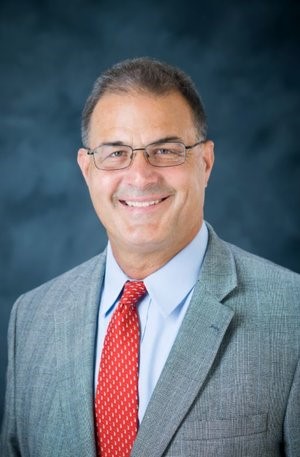
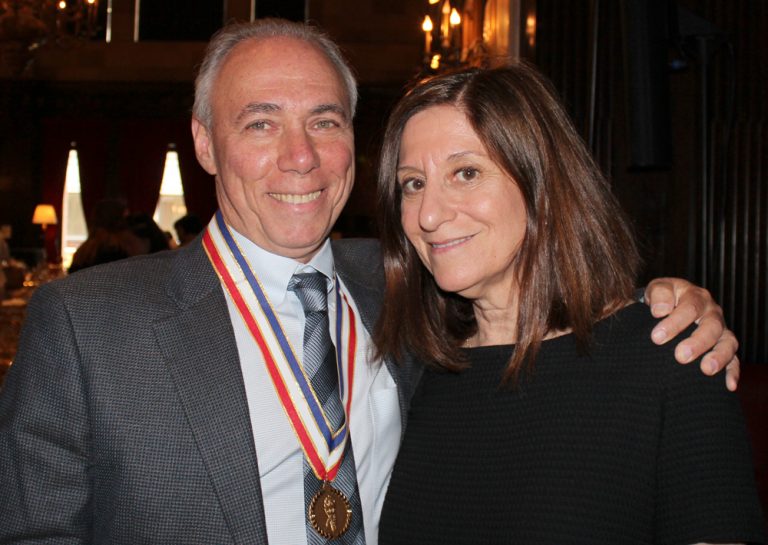
Long Island University has announced another important step forward in its continuing advancement as a nationally recognized teaching and research university by selecting Dr. Richard Nader as Chief Research and International Officer.

Dr. Nader will lead LIU Research and create a new Research Development office, where he will work alongside leadership and faculty to grow overall research and develop integrated global research and education partnerships.

Dr. Nader’s role will include strategic planning and working with faculty to build and enhance research and connect faculty to funding opportunities both nationally and internationally. His deep experience in university research development, program leadership at the National Science Foundation (NSF), and his international cultural competence with regard to country-specific needs are a vital background for his unique dual role as Chief Research and International Officer. Dr. Nader will be highly engaged with University leadership and faculty in enhancing LIU research emphasis areas and international engagement priorities.

“Long Island University’s bold vision is to be a globally engaged, internationally recognized teaching and research institution,” LIU President Kimberly Cline said.  “Rick Nader possesses the research, international and academic credentials, as well as the hands-on experience of building a globally agile research infrastructure, to further accelerate our momentum.”

“Rick Nader has a proven track record of building research programs with global relevance,” said LIU Senior Vice President for Academic Affairs Dr. Randy Burd. “At LIU, we are working to build an integrated and internationally relevant research enterprise driven by local discovery, national influence, global reach and collective impact.  Rick Nader will complement the outstanding faculty and resources we already have in place and further elevate our academic and research initiatives.”

“LIU has unique assets that position it to serve as a global research and education leader,” Dr. Nader said. “Leading universities, like LIU, demonstrate excellence in research and have a mission to prepare the next generation for success, which includes global understanding, cultural competence and leadership in an increasingly diverse world.  I am excited to contribute to the University’s forward momentum in academics and research. I look forward to working alongside faculty and staff to engage our students in research and global experiences that address society’s challenges.”

Dr. Nader has nearly 30 years of experience in research and international affairs. Most recently he served at Mississippi State University, where he led efforts in international development, education and research, including work with the University’s College of Veterinary Medicine. He also served at the University of North Texas (UNT), where he began its research development office and worked closely with faculty and senior administrators to secure major international and domestic research awards. Prior to his work at UNT, Nader was at the NSF’s Office of International Science and Engineering and at Texas A&M University.

LIU is advancing as a major research institution with enhanced initiatives in a number of fields, including LIU Pharmacy (The Arnold and Marie Schwartz College of Pharmacy and Health Sciences) and the University’s pending proposal to open the New York metropolitan area’s first College of Veterinary Medicine.  LIU Pharmacy is experiencing a dramatic increase in research funding under the leadership of Dean John Pezzuto, a Volwiler Award winner. Its new faculty include Dr. Jeffrey Idle, one of the world leaders in the fields of metabolomics and pharmacogenetics.  LIU’s pending College of Veterinary Medicine recently received a major boost when New York Governor Andrew Cuomo awarded the project $12 million in State transformative funding, citing its research focus.

University-wide, LIU is achieving results from its program of strategic investments. LIU was recognized as one of the top 20 selective private colleges in the nation on the “Overall Mobility Index,” assembled by researchers from Harvard, Stanford and Brown as part of the Equality of Opportunity Project. These accolades follow comparable laurels from such prestigious publications and research organizations as US News and World Report, Forbes, The Princeton Review’s “Best Northeastern Universities” list, and the Brookings Institution. LIU surpassed the goal of its strategic plan by doubling its endowment over the past five years, beating its target date by more than two years.

Dr. Nader will lead the LIU Research Administration and Research Development Office’s expansion to support faculty-driven research and intellectual engagement globally, as well as to guide LIU Global. He will lead the development of new resources to foster success, such as faculty proposal writing workshops, grant and research management training, and programming designed for LIU to operate effectively in research anywhere in the world. Dr. Nader will oversee federal research opportunities to spearhead development of LIU signature research areas, and build bridges between funding agencies and LIU.

# # #


LIU Brooklyn Professor Aaron Lieberman Is Named “Educator of the Year”

Dr. Aaron Lieberman, an associate professor in the Department of Counseling and School Psychology at LIU Brooklyn, has just been named “Educator of the Year” by Education Update, an award-winning newspaper based in New York with a circulation of 100,000 readers including teachers, principals, and superintendents in public and private schools among other “decision-makers in education.”

Learning about the honor caught Dr. Lieberman by surprise, he admitted.

Over the spring semester Dr. Lieberman had collaborated on a book called “Tools to Help Your Children Learn Math” with Dr. Alfred Posamentier, LIU Post Professor Gavrielle Levine and Danielle Sauro.  At the end of this project,  Dr. Posamentier, who serves as the executive director for International and Funded Programs at Long Island University, informed Dr. Lieberman that he was going to submit his name for the award.

“I thought it was a kind and thoughtful act and I subsequently submitted the required information to the newspaper, but I didn’t think anything more of it until I received an email informing me that I’d been honored with the award!” Lieberman said.

The event took place on June 22 at the Harvard Club. “I do photographer as a hobby and I’d shot a wedding at that venue years ago,” he recalled. “What a beautiful place!”

All modesty aside, Lieberman has been rightly recognized previously for his professorial prowess when he had been selected to receive Long Island University’s “Newton Award of Teaching Excellence.”

With a clinical background, Dr. Lieberman practiced his profession in a private clinical practice and working at the Committee for Special Education in the New York City public school system, among other professional activities.

Dr. Lieberman started at LIU Brooklyn as an adjunct in 1982 and began teaching full time in 1997. Over the years, Dr. Lieberman has served as the coordinator of LIU’s graduate programs for his department at the Brooklyn Campus, Westchester Campus, and Rockland Campus.

This past April he was presented a Service Award from LIU to commemorate his years spent in the classroom.

“Teaching is my passion,” he said. “You see the light going on in someone’s eyes when they get it—that ‘ahah!’ moment—it’s a beautiful thing and what I strive for.”

Lieberman’s scholarship has focused on Interprofessional Education and Interprofessional Practice (IPP/IPE), which emphasizes integration of the knowledge and the skill set of related professions toward holistic service provision and training.  He has also worked closely with speech language pathologists. His manuscript on emotional and behavioral issues in communication disorders was recently published in the American Journal of Speech Language Pathology.

His roots run deep at LIU. His father, Dr. Morris B. Lieberman, had graduated from the Clinical Psychology Program at LIU, had taught at the Brooklyn College of Pharmacy when it was a part of LIU, and had taught for many years in the psychology program and counseling psychology programs at the Brooklyn campus. His mother, Bilha Lieberman, was a graduate of the Guidance and Counseling program (as it was then called) at LIU Brooklyn. His brother, Shiloh Lieberman, who graduated from LIU Brooklyn with a B.S. as a pre-med student, was an active member of the Honor’s Program on campus and an editor of the school paper, “Seawanhaka.”

“I have a lot of connections with LIU,” Dr. Lieberman said. And many LIU students are no doubt grateful for all the ones he’s made with them in the classroom.

LIU Brooklyn to Host First Annual Conference on Linguistics, Language and Culture

Participants from across the country as well as overseas will be coming to the LIU Brooklyn campus this Friday for the first annual conference on the topic, “Intersection of Linguistics, Language, and Culture (ILLC),” which is being organized by Dr. Isabelle Barriere, associate professor in the Department of Communication Sciences & Disorders at LIU Brooklyn.

The all-day event is under the auspices of the National Science Foundation-funded Research Experience for Undergraduates Site Program (NSF-REU). Dr. Barriere collaborates on the program with Dr. Jonathan Nissenbaum of CUNY’s Brooklyn College.

Dr. Barriere says the program serves two purposes. “The first is to involve undergraduates in research projects that will contribute significant findings to the field of speech-language and communication sciences,” she explained. “The second is to simultaneously encourage and prepare minority students to undertake graduate work on diverse languages and cultures.”

“The program benefits from the tremendous ethnic, linguistic, and cultural diversity of Brooklyn and Queens,” Professor Barrière added, “and from the state-of-the-art research facilities, such as the LIU Downtown Brooklyn Speech-Language-Hearing Clinic, the Brooklyn College Linguistics Laboratory, the CUNY Graduate Center’s Developmental Neurolinguistics Laboratory, the Endangered Language Alliance, the Haskins Laboratories, and Yeled V’Yalda Research Institute.”

One of the highlights of the day is the New York City premiere of the documentary film, “Talking Black in America,” featuring a Q&A after the 1 p.m. screening with producer Dr. Renée Blake, a professor at New York University, in a discussion chaired by Dr. Margareth Lafontant of CUNY’s Medgar Evers College. The 1-hour-and-20-minute film was partly funded by the National Science Foundation.

More than a dozen students will be presenting projects they have conducted under the guidance of mentors including many from LIU Brooklyn, such as Elyanna Moskowitz’s “Variations of Yiddish Among Hasidic Preschoolers: Production and Preference,” Harmony Graziano’s “How to talk place in Hawaiian Creole English,” Daniella Shimoonov’s “Bilingualism vs. Trilingualism in Preschoolers Acquiring Russian, Hebrew and English,” Zian Jaffery’s “The Effects of Maternal Depressive Symptoms on Child Language Performance at 4 Years of Age,” Moné Skratt Henry’s “Phrase Boundary Blinks in American Sign Language,” Daniella Bonhomme’s “Code-switching in Different Generations of Haitian Creole Speakers in New York,” Saundra Scott’s “Impact of Dialectal Variation on Preschoolers’ Acquisition of Questions,” Zaib Javaid’s “Aphasia Group Member Self-Confidence Ratings and the Effect of Error Types and Totals.”

For more details about the program, click here.

Dr. Barriere credited the grant from the National Science Foundation for “giving undergraduate students in New York the opportunity to research on linguistic and cultural minorities so that they are better represented in research, both in terms of the students who do the research as well as the participants.”

Recently, Dr. Barriere and Dr. Nelson Moses, who founded the CSD department at LIU, were honored for their work with the non-profit organization, Making the Impossible Possible, with which they took students to Haiti for two weeks last summer. “Dr. Moses helped prepare the trip,” she said, “and with two clinical directors, I took 14 students who conducted evaluations and interventions there. It was very successful.” Accompanying Dr. Barriere at the awards gala, which was held on May 27 at BRIC House in Brooklyn, were two students who accompanied her to Haiti, Jasmine Philema and Blandine Joseph.

LIU Post Professor Chris Bates Shares His Wall Street Experience With His Students

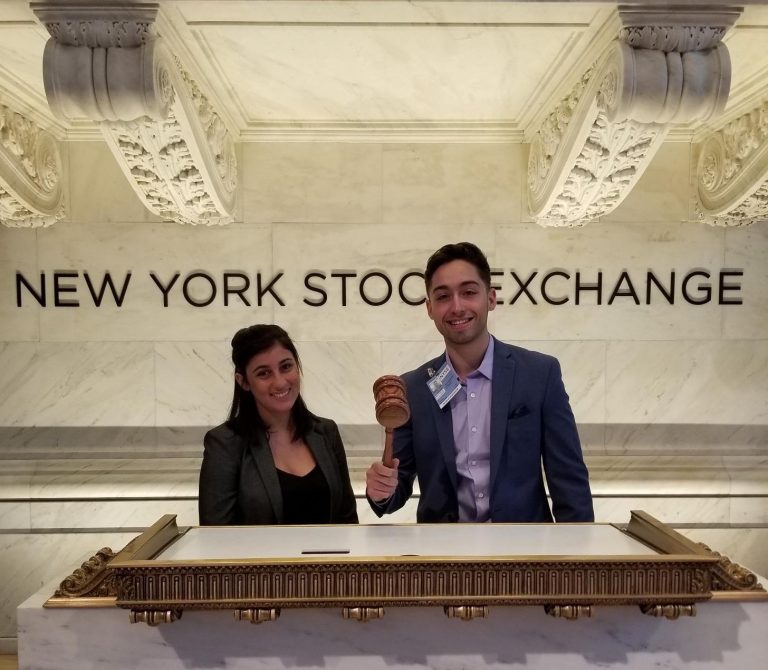
He might be new to the teaching profession, but adjunct professor Chris Bates is a veteran with a wealth of experience when it comes to the financial world. And so when he took two LIU Post students to the floor of the New York Stock Exchange in June, he was greeted there as an old timer by his former colleagues who welcomed him back.

From 1980 to 2004, Bates was a member of the stock exchange.

“My grandfather had passed away and I got his seat,” Bates explained.

Back in February 1980, Bates was taking night classes in criminal justice at John Jay College while working during the day as a clerk at NYSE for the firm of his maternal grandfather, George Robb, who lived across the street from his family in an affluent Queens neighborhood. On a winter evening when he returned from his job, his mother and father sadly told him that his grandfather had been found murdered at his home. Bates could see police and TV news crews still on the scene.

Bates left school, joined the exchange and eventually carved out a very lucrative career. When he retired from Wall Street as managing director of Goldman Sachs in 2004, he rang the closing bell—and struggled to keep his emotions in check.

Once he’d helped to get his six kids on the college track—in fact, one daughter just graduated from Post in May, while his youngest daughter Tara is a sophomore, and a third recently received her master’s in education from LIU —Bates decided to complete his own degree and so he came to Post.

Seated in the second row of Professor Sean Grennan’s criminal justice class in 2012, Bates was startled to learn that Grennan had been the NYPD homicide detective who helped crack his grandfather’s murder case—the murderer had been arrested months after the crime and ultimately served 26 years in prison. For both Bates and Grennan, that moment in the classroom provided some much-needed closure.

Bates got his bachelor’s and his master’s degrees within 22 months. And now at the College of Management, which is nationally renowned for valuing professional engagement in the classroom, he’s teaching his first class this summer, with more to come.

“It’s kind of weird how everything comes around again,” Bates said with a laugh. “I love my college—it’s my alma mater!”

So, on a recent June day, Bates took Jessica Milad, a senior who expects to graduate this winter with a bachelor of science degree in management, and Dylan Baldessari, a sophomore finance major who is president of LIU’s Finance Club, an extracurricular activity with about 25 student members that now boasts a portfolio of more than $100,000 thanks to donations. Both students were thrilled by the opportunity to accompany their professor to the heart of Wall Street.

“It really validated my love for finance,” explained Baldessari, “because I never knew what it was outside of textbooks. We met tons of people, a lot of analysts.”

“It’s always been a dream of mine to visit the floor of the stock exchange,” exclaimed Milad. “It’s something that not everybody gets to see—and we got a firsthand look!”

They also got to hold the gavel.

“One of the guys we met we ended up seeing on CNBC after we left,” she added. “It was very cool to have that insider experience because Professor Bates worked in finance for a very long time and he introduced us to everybody. We were able to get front-row seats, which was very exciting.”

“In the fall, I’m going to take my class to the New York Stock Exchange and hopefully that will be a larger crowd,” Bates said. “I do it because I love working with the kids!”

Xerox Picks LIU Alumnus Steve Bandrowczak to Be New President and COO

LIU alumnus Steve Bandrowczak (Post ’88, BS) has just been appointed president and chief operations officer of Xerox. He will also serve as a member of the company’s Executive Committee, starting June 25, 2018.

Bandrowczak, who holds a Bachelor of Science degree in Computer Science from LIU, will be responsible for developing and executing a global operations strategy in the company’s business support functions, including product and service delivery, customer billing, information technology, global procurement and real estate.

“Xerox is an iconic brand with a legacy of innovative technologies,” said Bandrowczak in a press release announcing his new appointment. “Joining the company at this time affords me the opportunity to help shape the next iteration of a global leader.”

“Steve brings a track record of growing businesses and enhancing competitiveness through a combination of innovation, technology and operational rigor,” said John Visentin, Xerox vice chairman and chief executive officer. “His breadth of experience across the product and service delivery chain will be essential to generating value for our shareholders and building more effective and efficient ways to serve our customers.”

Bandrowczak joins Xerox from Alight Solutions, where he was the chief operating officer and chief information officer, responsible for the company’s global supply chain, shared services, product development, transformation office, accounts payable, I/T strategy and operations, enterprise risk management and real estate.

Before coming to Alight Solutions, Bandrowczak was the president of Telecommunication Media and Technology at Sutherland Global Services. He previously served as the senior vice president for Global Business Services at Hewlett-Packard Enterprises, where he reportedly transformed its 16,000-employee shared service organization into a highly efficient operation with a focus on automation, business intelligence and labor optimization.

During his career, Bandrowczak has held senior leadership positions for various multi-billion-dollar global companies, including Avaya, Nortel, Lenovo, DHL and Avnet.

BSE Global and LIU Break Ground on Reimagined LIU Brooklyn Paramount Theatre

Revival of Legendary Theatre Underway
Click Here to See Brooklyn News 12 Report on the Event

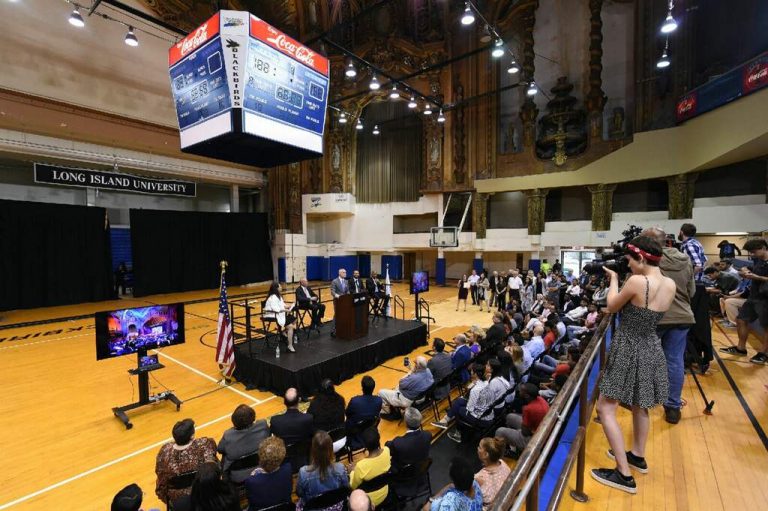
Executives from BSE Global and Long Island University were joined by Brooklyn Borough President Eric L. Adams in a groundbreaking ceremony for the renovation of the LIU Brooklyn Paramount Theatre, located at the intersection of Flatbush and Dekalb Avenues in Downtown Brooklyn.

The renovation and operation of LIU Brooklyn Paramount Theatre will be overseen by BSE Global, the same team behind Barclays Center and NYCB LIVE, home of the Nassau Veterans Memorial Coliseum. H3 is the architect of record, and Shawmut will be managing the construction.

The renovation will revive the 90-year old venue by retaining and restoring many of its existing features, while modernizing the space to meet today’s standards. The entrance will be moved back to the theatre’s original corner location at Flatbush and Dekalb Avenues; a loge level balcony and box office will be reestablished; and updates will be made to the lighting, restrooms, and sound systems, among many other aesthetic upgrades.

The renovation is expected to create 200 construction jobs, and nearly 100 additional positions at the completed venue.

BSE Global will be responsible for programming the venue, which will be home to a wide range of events. While the theatre’s main focus will be revitalizing its legendary music roots, it will also host a mix of family entertainment, comedy, sporting events, special events, and private programs for LIU students. The 3,000-person capacity venue will house a flexible seating configuration that will accommodate primarily general admission-style setups, with the opportunity also to do seated floor events.

In addition, the revamped venue will provide a variety of opportunities for LIU Brooklyn students to gain hands-on industry experience, including internships, work-study programs, part-time jobs, and more. Below is an architectural rendering of what the refurbished facility may look like once its transformation is completed.

CENTER STAGE VIEW - credit H3.jpg

“I am excited to take the next step with the renovation of this historic venue,” said Brett Yormark, CEO of BSE Global. “The addition of Paramount to BSE Global’s venue pipeline, which includes Barclays Center, NYCB LIVE, and Webster Hall, enables us to connect with artists at all points in their career. Paramount will also offer a greater array of entertainment options for Brooklyn and provide employment opportunities for students and those in the surrounding area.”

“The refurbishment of the LIU Paramount Theater is a major milestone in the history of Long Island University,” Long Island University President Dr. Kimberly Cline said. “It brings our commitment to the arts-and our role in the arts community-to an entirely new level for our students, faculty, and alumni, and solidifies our role as a major cultural driver in Brooklyn. There is no better place in the world to learn about the arts than Brooklyn, and there is no University that is more committed to combining great academics taught by world-class faculty, with experiential learning and hands-on opportunities for students.”

Brooklyn Paramount operated from 1928-1962 as a live performance venue and was the first theatre in the world designed to show talking movies. The Rococo-style ceiling and wall trimmings that still remain once served as a grand accompaniment to many celebrated performances by artists such as Frank Sinatra, Ella Fitzgerald, Miles Davis, Bing Crosby, Buddy Holly and Chuck Berry. After closing its doors, the theatre became part of LIU Brooklyn’s campus and served as a multi-purpose space for students, staff and guests. For many years it was the home court of the LIU Brooklyn Blackbirds basketball team. To mark the new beginning, the scoreboard was ceremonially lowered to the floor as the guests watched approvingly. Soon a magnificently renovated Paramount will rise again.


LIU Professor Emeritus Dr. Rocks Is a Hit as First Scientist on a Topps Baseball Card

LIU Professor Emeritus Dr. Lawrence Rocks has just become the first scientist to be named on a Topps Baseball card–and the Major League is abuzz with the news.

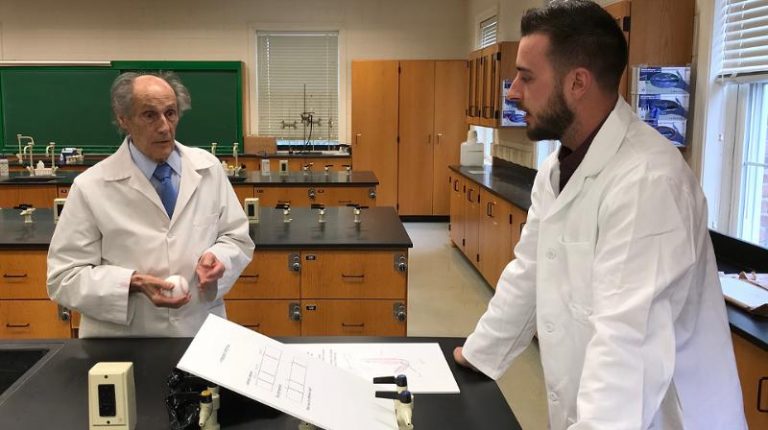
In a lab experiment conducted at the Post campus last winter, Dr. Rocks had teamed up with St. Louis Cardinals’ shortstop Paul DeJong, who majored in biochemistry at Illinois State University, to test the old adage that a baseball travels further the hotter it gets. The results weren’t quite what they expected.

“If you heat a baseball to a very high temperature, it  gets mushy, and if you chill it, it gets brittle,” Dr. Rocks explained the results to Jim Hayes, a Fox Sports reporter who covers the Cardinals. “The in-between is where it’s very flexible. At 75 degrees it’s best. But the baseball has multiple layers so the inside temperature is never the skin temperature.”

Dr. Rocks, an LIU Chemistry professor who authored the landmark book, “The Energy Crisis,” in 1972, worked closely with Congress to create the Department of Energy. His son, Burton Rocks, is DeJong’s sports agent.

“Paul was interested in my father’s life—having read a lot about him,” explained Burton Rocks, “and he wanted to one day be his lab assistant.”

Just released the second week of June, the new 2018 Topps Futures Stars baseball card describes DeJong as a “lifelong science ‘nut’ ”  who “spent time in the offseason applying his avocation to his profession. He worked with world-renowned scientist Dr. Lawrence Rocks to study the effects of heat on a baseball.”

A spokeswoman for Topps, Susan Lulgjuraj, confirmed that it’s the first time a scientist has been named on the back of a flagship card. “Generations of baseball fans have used cards to learn math through statistics, reading and just general fun,” she added. “We are thrilled to help spread the world and inspire curious minds to explore.”

Dr. Rocks saw his lab experiment with DeJong as a chance to score educationally with young baseball fans.

“In addition to research I’m working on with sports chemistry and analytics,” Dr. Rocks explained, “I wanted to convey to children the nature of experimentation in the method called ‘science,’ as I believe science is not a subject but rather a method. We wanted to inspire young people everywhere that they can do science. All it takes is curiosity, imagination and objectivity with results.”

Seated in a dugout with the young shortstop recently, the 84-year-old esteemed scientist was asked by a reporter how DeJong handled himself in Pell Hall.

“He was great,” Dr. Rocks told Fox Sports. “He made friends with everybody—from the chairman of the department all the way across the board to the lab assistants and the girls watching him—he was terrific and very careful in the observations.”

“We thought that it was an experiment where we could really control the variables with just looking at heat,” DeJong, 24, told the reporter, “and it turned out we got some really decent conclusions from it—and I got to wear a lab coat, so all good news.”

In the lab, the two men dropped a baseball from the height of 50 centimeters to measure how high it bounces depending on its temperature. The experimenters found a surprising bell curve with their results. The baseball has a sweet spot when the temperature ranges between 68 degrees and 78 degrees, but once it reaches over 80 degrees, its bounce starts to decline significantly.

“As you increase temperature, the elastomers get a little mushy,” Dr. Rocks told CBS News last fall.

DeJong made his major league debut on May 28, 2017, at Coors Field against the Colorado Rockies when he hit a home run on his first swing. Later in the season against the Mets, he racked up three doubles and a home run, setting both a Cardinals shortstop and a number eight hitter record with four extra-base hits in one game. The New York Post headlined DeJong’s exploits with a touch of irony: “Meet the newest Mets-killer, whom they nearly drafted.” DeJong signed with the Cardinals in 2015.

“Reimagining Constructs” Kicks Off Summer Exhibition at Steinberg Museum of Art

An intriguing new exhibition at Steinberg Museum of Art explores how artists use structures to understand their surroundings—both natural and man-made.

Called “Reimaging Constructs and Surroundings,” the exhibit features the work of Darlene Charneco, Heejung Cho, Ana Golici, Cheryl Molnar, Jason Paradis and Winn Rea, who is a faculty member of the Art Department at LIU Post. All the artists have Long Island roots, stretching from the Hamptons to Brooklyn. Two are currently working on international exhibitions—one in Romania, which has become a hotspot for contemporary European art collectors, and the other in South Korea.

The guest curator for this exhibition is Dawn Lee, who is art curator of the Omni Gallery in Uniondale.  She is also an artist, professor and chair of the art department at St. Joseph’s College, and coordinator of the artist-in-residency program at Fire Island National Seashore. When she puts an exhibit together, Lee says what she enjoys most is seeing how the artists interpret things like nature, spirituality, personal experiences, social issues and aesthetic concerns and flesh out these concepts in different ways.

“With this collection of artwork I believe that I was able to include a group of artists who explore meaningful aspects of their environment and experiences including responses to natural, manmade, and personal spaces in which they find value,” Lee said. “I hope the viewers are able to enter these spaces and discover qualities that correspond with their own lives and reveal new perspectives.”

As the program’s statement explains, the works now on view at Sternberg Museum of Art  “reflect the innate human need to establish order from the interwoven aspects of our complex existence.”

Here’s a closer look at the artists included in this free exhibit, which runs until July 27, 2018. On Sunday, July 15, there will be a special reception at the museum from 4 p.m. to 6 p.m.

Darlene Charneco utilizes techniques seen in mapping to look at how people forge their own networks to create a continually expanding community, and to enlighten how human existence is a trace of connections.

Heejung Cho is interested in how the understanding of our environment can be a personal experience. She focuses on objects of familiarity and how these structures and our emotions attached to them are continually evolving, ultimately becoming an “architectural abstraction over time.” Her brick wall pieces provide dynamism, repetition, uniformity of construction.

 Ana Golici explores a boundary of human understanding, the natural environment. By enlarging select elements, and her choice in layering materials, Golici illuminates the complexity yet fragility of the interconnecting web of structures that make up the whole of an organism, such as coral or an insect wing.

Cheryl Molnar juxtaposes the natural with architectural features in a collage process of fragmentation and reassembly that mimics the alteration of natural landscapes by human development.

Jason Paradis deconstructs an experience of the night skies with relation to self and concept of time. Creating a framework through lines, planes, and found materials, Paradis explores the voids and connections of a space vast and beyond.

Winn Rea reinterprets the landscape through an aerial perspective provided by maps. Among her understanding of the topography of the land, she inserts the viewpoint of one’s experience in their immediate surroundings with suggestions of the foliage and shadows of natural elements.

Normal summer hours for the museum are Monday through Friday, from 9:30 a.m. until 4:30 p.m. The gallery is located on the ground floor of the Palmer Library building on the LIU Post campus. For more information, call 516-299-4073, or go to liu.edu/museum.

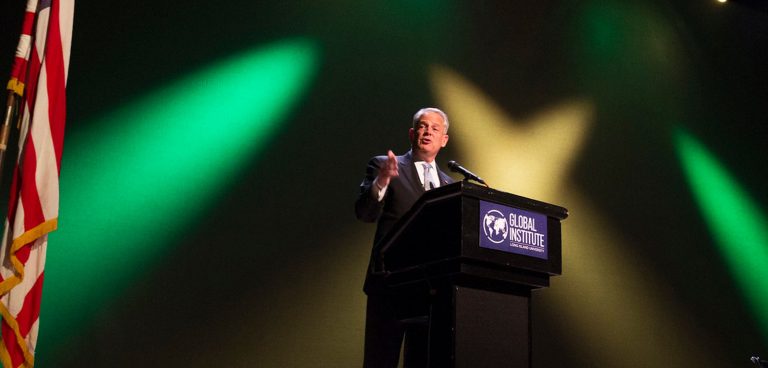
LIU Global Institute Chair Steve Israel Pens Daily News Op-Ed

In the aftermath of the historic meeting between President Donald Trump and North Korean leader Kim Jong Un, LIU Global Institute Chairman Steve Israel, along with (ret.) Major General Robert Scales, who served as commandant of the U.S. Army War College and as a field artillery battalion commander in South Korea, co-authored an Op-Ed that ran June 13 in the New York Daily News urging the United States to continue our country’s important training exercises with South Korea because it is essential to combating a possible invasion from North Korea.

“These exercises must proceed,” they write. “Not in a flashy or provocative way, but in a way that makes clear to the North that any potential invasion will be met by an unstoppable phalanx of American fighting power that the North has no hope of defeating.”

The article, headlined “Why U.S.-South Korea war games must continue,”  offers in-depth analysis and questions the concessions made by President Trump in his recent summit with North Korean leader Kim Jong Un in Singapore.

Read more here.