Home Blog Page 132

Internationally acclaimed photographer Dana Gluckstein to kick off grand opening of Steinberg Museum of Art at LIU Post on October 18th

Brookville, NY –Long Island University is pleased to announce that award-winning artist Dana Gluckstein will be on campus for the Oct. 18th premiere of her powerful exhibition titled “DIGNITY: Tribes in Transition.” Gluckstein’s remarkable exhibit chronicles her decades spent photographing Indigenous Peoples as they struggle to maintain their identity in a changing world.

“It’s my sincere wish that DIGNITY will serve as a call-to-action in support of all Indigenous Peoples,” said Gluckstein, shown above with three generations of San women. Her DIGNITY advocacy campaign in association with Amnesty International created a tipping point for President Barack Obama to endorse the United Nations Declaration on the Rights of Indigenous Peoples in 2010.

“We’re thrilled to present compelling photographs by Dana Gluckstein as we introduce our newly renovated Steinberg Museum of Art,” said Barbara Applegate, museum director. “We invite Long Islanders to be inspired by our unique visible storage suite that makes viewing our collection of 5,000 objects feel limitless.”

“The Steinberg Museum of Art provides our students with unique experiences that reflect our entrepreneurial spirit while supporting engaged learning and high-quality research,” said LIU President Dr. Kimbely R. Cline. “Dana Gluckstein’s work embraces each of these values with sensitivity and beauty.”

“Nothing inspires or instructs more profoundly than great art and architecture,” said Steven Breese, Dean of the College of Arts, Communications & Design at LIU Post. “At this special event, the Steinberg draws together these two powerful forces: the compelling photographs of Dana Gluckstein coupled with the unveiling of the Steinberg’s new exhibition gallery and innovative visual storage. We are proud to offer our students, faculty and community the opportunity to experience this very special exhibit – and, like all great art, we know that you will find DIGNITY beautiful, insightful and powerful.”

Chanter in Hawaii, photo taken by Dana Gluckstein in 1996.

“DIGNITY: Tribes in Transition” opens October 18, 2018  and runs until March 8, 2019. Dana Gluckstein will speak on opening night and sign copies of her book. Earlier in the day she’ll meet with students to discuss her work. The show will open to the public at 7 p.m. 

For more information about Dana Gluckstein, go to www.danagluckstein.com

The Steinberg Museum of Art is on the ground floor of the B. Davis Schwartz Memorial Library, 720 Northern Boulevard, Brookville, NY 11548.

(Photo of Dana Gluckstein with three generations of San women taken by Tai Power Seeff)

LIU Partners with Rep. Tom Suozzi to Expand Long Island’s Biotechnology Industry

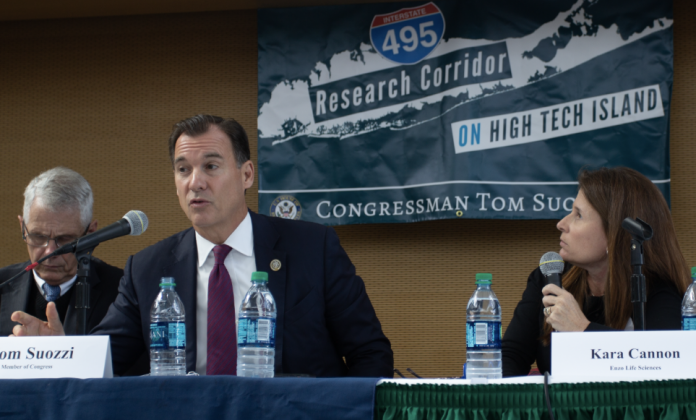
Rep. Tom Suozzi talks about transforming Long Island's economy as John Preston, founder of MIT Technology Licensing Office, and Kara Cannon of Enzo LIfe Sciences listen during a panel discussion held at the Tilles Center at LIU Post on Sept. 24th.

How to turn the Long Island Expressway into “The 495 Research Corridor” was the issue raised here by Congressman Tom Suozzi when he hosted a conference Monday at the Tilles Center for the Performing Arts that brought together more than 70 leaders in the fields of biotechnology and life sciences.

“Today’s forum is to promote our region as the premier research destination for life sciences and to provide for the continued growth of Long Island,” said LIU President Dr. Kimberly R. Cline as she welcomed the participants. “Innovation is at the forefront of everything that we do at LIU, and our increasingly robust research agenda speaks to our commitment to join with others on Long Island so we will truly be known as High-Tech Island.”

She added that the panelists assembled at the LIU Post campus are proof that Long Island is ready for an investment in time, energy and talent to transform our region and make us a driving force in life sciences for decades to come.

“We have a cluster of businesses and research institutions that already exist here,” said Rep. Suozzi (D-Glen Cove), who noted that New York State is the third largest recipient of research dollars in life sciences in the country, right behind California and Massachusetts. “The challenge is that the money that comes here is not matched by private sector investment.”

As Newsday noted, the state receives $2.2 billion in National Institutes of Health grants, and $1.7 billion of that sum goes to New York City, Long Island and Westchester. Suozzi said that his goal is to demonstrate that Long Island’s expertise stretches along the LIE from the Brookhaven National Laboratory to Cold Spring Harbor Lab and the Feinstein Institute for Medical Research in Manhasset. He credited Kevin Law, president and chief executive officer of the Long Island Association, who was also a panelist, with coining the phrase, the 495 Research Corridor.

“We’re very fortunate to have LIU participating,” said Law, who praised Dr. Cline for her role in promoting the Island’s vital transformation. “We have over 25,000 Long Islanders already employed in the life sciences industry,” Law noted, “and that is more than Grumman ever had in its heyday.” Until its manufacturing facilities shut down on Long Island in 1996, the Grumman Corporation was once one of the nation’s largest aerospace contractors. Law told the conference that Gov. Andrew Cuomo has recognized that Long Island has the best chances of any region in New York to take the lead in pushing life sciences to new breakthroughs.

The featured speaker was John Preston, founder of the MIT Technology Licensing Office, who was introduced by Dr. Randy Burd, Senior Vice President for Academic Affairs at LIU.

“He really stands at the forefront of technology transfer,” said Dr. Burd, “and he is always pushing the boundaries of innovation.”

As Preston told the audience with a smile, “The rate of technological change is insane right now. It’s hard for me to even keep up with it, and I spend my life working on technology.” Currently, Preston is the managing partner of TEM Capital, a privately held equity investment company, as well as the director of many private companies. He compared Long Island’s economy favorably to that of other countries and saw a great deal of potential in Suozzi’s initiative if small-dollar investors can be encouraged to get in on the ground floor.

“Right now, only the ultrarich are getting invited to do the founding investment,” he said.

Kara Cannon, global head of sales and marketing for Enzo Life Sciences, Inc., a leading life sciences and biotechnology company, said that her division has almost 400 employees working on Long Island. “We’re committed to staying here,” she said, and praised the forum for connecting established companies, startups and investors. “There’s a lot of technology and opportunity on the Island.”

And Long Island University is proud to play its part.

LIU Post Hosts University of Salzburg Dean to Discuss How Students Can Learn More About Teaching Diversity in a Changing World

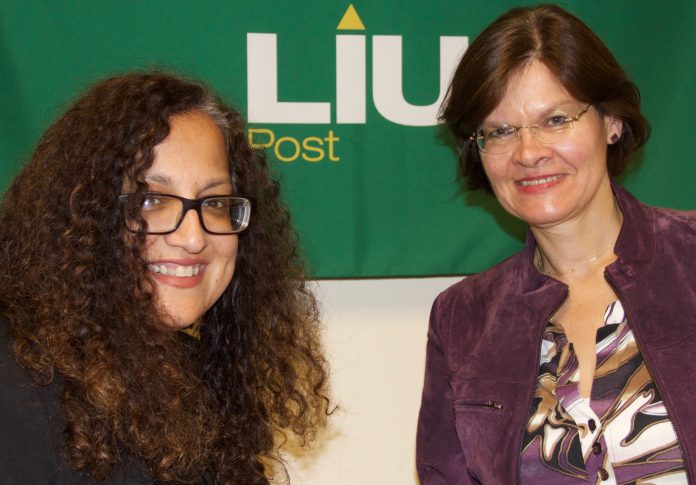
LIU Post Professor Shaireen Rasheed, left, and Dr. Ulrike Greiner, Dean of the School of Education at the University of Salzburg

As a further sign of the growing collaboration between LIU and the University of Salzburg, its Dean of the School of Education, Dr. Ulrike Greiner, came to the College of Education, Information and Technology as a visiting professor and gave a public lecture on “The Austrian Landscape and the Diversity Beliefs of Students.”

Dr. Greiner’s host was Professor Shaireen Rasheed, who recently became the co-director of the doctoral program in Interdisciplinary Studies at CEIT. They first met in 2016 when Dr. Greiner visited LIU Brooklyn. Last year, thanks to a Fulbright scholarship, Professor Rasheed spent two weeks at the University of Salzburg, working with undergraduate and doctoral students as well as giving a public lecture at the Austrian university. She has also been doing research in Europe on immigration issues—a topic that has become increasingly charged on both continents.

“I found out from my work over there that even though the issues are different, they are not uncommon. They overlap,” said Professor Rasheed. “The challenges are the same.”

This spring Dr. Greiner and Professor Rasheed virtually co-taught an undergraduate course via Skype and Blackboard so education majors from both LIU and the University of Salzburg could learn about teaching diversity within an international framework. The professors hope to initiate a month-long exchange program beginning next spring with students and faculty.

One of the LIU Post students who participated in last semester’s cross-Atlantic class via the Internet was Georgina Peralta, a junior majoring in childhood education with a specialization in Spanish.

“We asked the Austrian students what kind of economic and academic challenges they go through,” she said. “It was very refreshing to walk in someone else’s shoes from across the world.” She found the experience very rewarding. “It made me think about policymaking and what goes into the laws of education.”

“We should exchange students so they get to know a broader horizon of how teaching and learning works in different countries,” said Dean Greiner. She cited a recent study that found that one of every two students attending Austria’s primary schools is multi-lingual, meaning that even though they might be born in Austria, their parents were immigrants—and German was not the only language spoken at their new home.

“We have an increasing number of students coming from a diverse background,” she explained, “so we have to equip our teachers to handle a really diverse classroom. We have to adapt our pedagogy.”

Student demographics have also been changing in American classrooms, noted Professor Rasheed, who stressed how important diversity training is for today’s educators. “When you have teachers who are more aware of cultural diversity, it makes for better students, and it makes for a better climate in the school.”

Until now, just the business schools at LIU and the University of Salzburg had formed a relationship, so this collaboration marks the first time for the colleges of education.

So far, five LIU undergrads have signed up for the spring exchange program, and there’s room for many more.

“We will really mentor them,” said Dean Greiner. The LIU students will be placed in English classes in Salzburg so they can observe classroom instruction firsthand, and they’ll be taken on cultural outings to Vienna as well. “One month gives you the opportunity to change your beliefs and have a deeper experience,” she noted. In the fall, students from the University of Salzburg are expected to come to LIU. “Our schools want teachers with international experience,” Dean Greiner added. “What you gain is experience in adapting to new situations.”

In October, Dean Greiner, in conjunction with colleagues in Political Science, Philosophy and the Teacher College in Salzburg, is co-hosting an international conference at the University of Salzburg on the topic, “National Populism and Education,” and Professor Rasheed will be the keynote speaker.

LIU Brooklyn Alum Names New Academy in Liberia After Her English Professor Here

A special day for students at the Josephine Clark Academy, a school founded in Liberia by Rose Kingston, a graduate of Connolly College who named it after her English professor at LIU Brooklyn

When LIU Brooklyn Professor Josephine Clark learned that her former student had actually founded a school in Liberia and put her name on it, she said she nearly fell out of her chair.

“It was mind-blowing!” exclaimed Clark, an adjunct English professor who’s been teaching at the Brooklyn campus for almost three decades. Rose Kingston, a dance major, had taken Clark’s non-Western Literature class in the Fall 2012 semester, and she was struggling. “I remember that Rose seemed a little bit timid when she first came to my class.”

“Professor Clark inspired me,” said Kingston (Brooklyn ’14, BFA). “She helped develop in me the love of learning.”

Born in Liberia, Kingston had left that West African country in the middle of its first civil war when she was 9 years old. Third grade was as far as she’d gotten in school. She’d seen the bodies of dead civilians, been shot at, and survived a rocket attack on the ship leaving the seaport that would take her to a refugee camp in Ghana. She came to America when she was 15.

“I was placed in the ninth grade because of my age, not my ability,” Kingston said. She managed to graduate from Sheepshead Bay High School in Brooklyn (no longer in operation) and enter LIU. There, in her dormitory, she followed up a recommendation from her freshman orientation and signed up for her first counseling session.

“I was so depressed. I think I was suffering from symptoms of PTSD,” she recalled, marveling over the impact the psychologist had on her. “I was able to pull together and understand what was happening to me and put names on my different emotions.”

But it was in English 64 where she encountered Professor Clark.
“I felt I couldn’t read,” Kingston said, and she asked her teacher to recommend a class that would help her improve. “She said, ‘You’re smart. You just need someone to fully understand where you are academically and to help guide you through this process. And if you would agree, I will tutor you.’ I thought she was joking. And she said, ‘I’ll tutor you every Saturday from 10 to 2 o’clock. If you come on campus, I’ll come on campus.’

“Her dedication and her focus were unbelievable,” Professor Clark said. “A lot of it was reading and comprehension—and confidence.” In those sessions, they bonded. Clark went to her graduation ceremony from Connolly College in 2014, but then lost touch with her student. In the meantime, Kingston had gotten her Master’s in Education from Montclair State University in New Jersey—and returned to her native country.

In 2016, Kingston founded the Josephine Clark Academy in an abandoned warehouse on a piece of land she owned in a village about seven miles from the country’s capital, Monrovia.

“The community I live in didn’t have any schools,” said Kingston. She started with 14 children, one of them her own son; today she has 43 students, ranging in age from 3 to 16. Her goal is to craft an individual education plan so each one could overcome the gap in their education because of the war. “They don’t have a learning disability,” she said. “They just have a deficiency because of the lack of resources.”

Besides running her new academy, Kingston also teaches English language arts and dance, too. She says she’s the only ballet teacher in Liberia.

Looking back, Kingston has many people to thank for helping her stay on track at LIU Brooklyn. She credited the dance department as well as her counselors at the Arthur O. Eve Higher Education Opportunity Program (HEOP), named after the former Deputy Speaker of the New York State Assembly.

“The HEOP program has been instrumental in the lives of so many students here who couldn’t have survived—especially that first year of college—without the counselors and the support people and the tutors that HEOP provides!” explained Professor Clark. “It  gives them the chance to find out all that they really can do.” According to HEOP director Kamel Boukerrou, 275 students are currently enrolled in the program at LIU Brooklyn.

“Thank God for HEOP because they gave people like me a second chance,” Kingston said. “I’m so grateful to everyone who helped me at LIU.”

A couple of years ago, Clark was recovering from surgery when she suffered a life-threatening blood clot. “I should have died that night,” Clark recalled. “Afterwards, I kept asking myself, ‘Why am I still here?’ I said, ‘God, what is it you want me to do? Do you have more students at LIU that you want me to go and harass?’ All of a sudden this year, I get this information; so I said, ‘Well, I guess I need to be here!’ I really thought that she was just joking when she told me that one day she was going to open a school and name it after me.”

“What better name to give this school than ‘Josephine Clark Academy’?” Kingston exclaimed. “Every time I say the name, I remember what LIU did for me through Professor Clark!”

Currently Kingston is working to establish the Josephine Clark Academy Foundation in the United States to make it easier to obtain financial support to expand her program—and shrink the long waiting list of children eager to learn at a school in Liberia named after her inspiring LIU Brooklyn English professor.

“This story is exemplary of LIU at its best,” said Dr. Leah Dilworth, chair of the English Department at LIU Brooklyn, adding that Kingston’s accomplishment was another example of the good work that teachers and students are doing here every day.

In the photo above, Rose Kingston, left, poses with her teacher, Professor Josephine Clark, at a recent visit to the LIU Brooklyn campus this summer. To get more information on the academy, contact Rose Kingston at roskingston@yahoo.com 

Research Trip to Israel Is a Resounding Success for Seven LIU Post Students Studying Bats in the Desert

This August, seven LIU Post students joined Dr. Kent Hatch, an Associate Professor of Biology, to study the behavior of bats in the desert of Israel.

From July 27th until August 14th, Aaron Mayo, Daniela Mathieu, Disha Lumsir, Chanpreet Singh, Mallory Slack, Simone Smith and Indira Rojas were in the Israel conducting research as part of a Biology 290 course. The course itself was created and taught by an international team of professors from Israel, Italy, and the US and included not only the LIU students, but five students from Israel and one India. Working alongside Israeli graduate students at the Ben-Gurion University of the Negev, the LIU students were testing two hypotheses about bat habits—and managed to disprove both of them.

The goal of the first study was to find out how loud music, often played at campgrounds, can effect bat behavior at night when they are feeding, and the second study was meant to see if temperature determines where bats choose to roost for the night.

Using specialized mist nets, the students helped catch the bats and hold them for about a week so they could analyze their behavior.

Despite the old saying, bats aren’t blind. They can see as well as humans. At night, they use sound waves and echoes—a process called echolocation—to navigate and find food in the dark. According to Dr. Hatch, the study revealed that the lower frequencies of campground music that are audible to the human ear don’t bother the animals because they rely on higher frequencies of sound to get around.

To test the second hypothesis, the students released the bats into a chamber that had one roost at a cool temperature and the other at a warmer temperature. Surprisingly, bats in groups of two or more preferred the warmer roost, while solo bats chose the cooler one. Researchers had thought the bats would do the opposite.

Dr. Hatch praised the LIU students for working hard every day starting at 8 in the morning and lasting until midnight—and impressing their academic colleagues.

“They did really well and got lots of compliments from the Israeli professors and the Italian professor there,” said Dr. Hatch.

With hard work comes great rewards: students also got the opportunity to travel while they were in Israel. One weekend, they took a trip to the Dead Sea. Later they visited the coastal city of Eilat on the Gulf of Aqaba, where they hiked in the mountains, which proved to be one of the highlights of the trip. When the course was completed, they spent time in Tel Aviv and Jerusalem, where they rejoined some of the Israeli students they’d befriended in the desert.

“It was hard and a lot of work,” said Aaron Mayo (Post, ’19), “but it was rewarding. Honestly, I look at research in a whole new light.”

Diana Ross, Pat Benatar and George W. Bush Highlight This Fall’s Season at Tilles Center

The incomparable Diana Ross takes the Tilles Center stage on Oct. 6.

Tilles Center for the Performing Arts at LIU Post begins its 2018-2019 season with a remarkable line-up this fall. Among the featured guests are the supremely talented Diana Ross, a pair of very funny guys, Steve Martin and Martin Short, the iconoclastic rockers Pat Benatar and Melissa Etheridge, plus NFL sports icon Terry Bradshaw and former President George W. Bush, just to name a few.

“We always present world-class orchestras, unique dance performances and national Broadway tours but now we’ve also added more classic rock and pop shows,” said Shari Linker, Tilles Center’s director of communications and engagement, who wanted to remind LIU students that “it’s not just your father’s performing arts center!”

Indeed, the Tilles Center’s diverse programming appeals to an audience of many generations. And, of course, there’s not a bad seat in the house.

As always, LIU students with the proper ID can receive discounts that range from $15 to $20 a ticket, depending on the show and available seating. Students also have the chance to work in the box office, be an usher at performances, or become an intern in the administrative office.

“We are always looking for students,” said Linker. “In fact, many of our full-time people started off as students here.” She suggested that interested students drop by the Tilles Center office located off the Goldsmith Atrium and speak to whoever’s sitting at the front desk.

The new season officially gets underway on Sept. 13th  when former quarterback and current TV sports analyst Terry Bradshaw takes the stage at 8 p.m. for an inspirational and, no doubt, hysterical evening moderated by WFAN’s Mike Francesa.

Next up on Sept. 22 will be Neil Sedaka, the multi-million selling pop star known for his 1960s’ radio chartbusters like “Calendar Girl” and “Breaking Up Is Hard to Do.” He penned his “Stairway to Heaven” a decade before Led Zeppelin unleashed theirs—and the title is their only similarity. He’ll be followed on Sept. 28 by the highly entertaining Jon Batiste, best known for leading his Stay Human band on The Late Show with Stephen Colbert. Here he’ll be diving deep into the American musical landscape, ranging from the early jazz of New Orleans, where he’s from, to the sounds of the present.

Diana Ross—Motown singer who founded the Supremes, actress (“Lady Sings the Blues”) and record producer—kicks off the Gala 2018 show at Tilles Center at 8:30 p.m. on Oct. 6. Billboard magazine named her the “Female Entertainer of the Century” in 1976. Forty years later Ross received the Presidential Medal of Freedom, the nation’s highest civilian honor, handed to her by President Barack Obama at the White House.

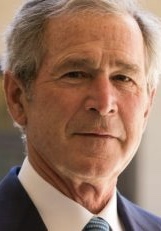
In partnership with the Global Institute at LIU, headed by former Democratic Congressman Steve Israel, Tilles Center will present a talk by President George W. Bush at 7 p.m. on Oct. 25, less than two weeks before the November mid-term elections, so what he has to say could have national repercussions.

Also on the bill in October are Melissa Etheridge on Oct. 7, as well as Pat Benatar and Neil Giraldo, who will perform an acoustic show on Oct. 12, which marks LIU Post’s Homecoming weekend. Long Island native and hit EDM artist 3LAU (aka Justin Blau) is set to play the 2242-seat Concert Hall the night before.

A much smaller venue, the recently renovated Krasnoff Theater at Tilles Center, formerly Hillwood Recital Hall, gets its grand opening on Sept. 28. So stay tuned for that event’s special line-up.

Those wild and crazy guys, Steve Martin and Martin Short, say they’ll provide “An Evening You Will Forget for the Rest of Your Life” at the Tilles Center on Nov. 18. Whether they’ll live up to their promise remains to be seen.

For a closer look at the Tilles Center calendar of events, click here.

Unique partnership with Northwell Health offers LIU Post nursing students training in the right way to lift patients–and prolong their careers

For the first time on a university campus thanks to a unique partnership with Northwell Health System, nursing students at LIU Post will get hands-on experience in using state-of-the-art equipment to move patients properly, safely and comfortably.

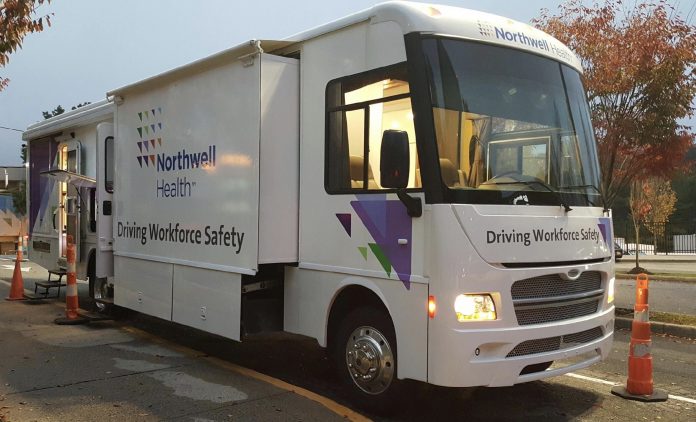
In a joint effort with the School of Health Professions and Nursing, The LIU Post Interprofessional Simulation Center and Northwell’s Work Force Safety Department, third-year nursing students will learn how to do it right when Northwell’s innovative Safe Patient Handling and Movement (SPHM) Mobile Training Center pulls up to the Brookville campus on Sept. 6 and Sept. 7. The van comes packed with the newest devices in patient-lift technology designed to eliminate stress on health-care staff.

“I think it’s extremely important for our future nurses to avoid injury,” said Teresa Heithaus, MSN, RN-BC, assistant professor in the School of Health Professions and Nursing at LIU Post. According to the U.S. Bureau of Labor Statistics, nurses and nurses aids rank among the top 10 professions in the country for suffering spinal injuries because repeatedly lifting patients manually over the course of their careers takes a heavy toll. Heithaus is the faculty leader for this course.

“We’re going to give the students Safe Patient Handling 101,” explained Paul Power, a trained paramedic and director of Work Force Safety for Northwell Health, who oversees the training van program. “Nursing and health care are very physically demanding. We want to teach them how to protect their bodies because by protecting themselves, they’ll protect their patients, too.”

Under a recently passed New York State law, every health-care provider who works in a hospital or a nursing home now has to be trained annually in safe-patient handling. For Northwell’s Power, that mandate means instructing some 25,000 staff people a year. This visit to LIU marks the first time the van has come to a campus, he said.

“We have the only mobile safe-patient training center in the world,” he said. “It’s a one-of-a-kind vehicle—essentially, it’s a simulated hospital room on wheels.”

According to LIU Post’s Heithaus, making health-care professionals aware of technical advances in patient lifting is key to promoting career longevity because “there’s no safe way to lift an adult patient manually.”

All told, 80 third-year nursing students, divided into groups of eight, will get the training, which will be held in half a dozen sessions lasting 45 minutes each over the course of two days. Moving forward, she hopes to involve the entire school in this program. Instead of a live human being, the students will be handling a mannequin. Just as important, they’ll be working with a fully functioning hospital bed equipped with the latest features.

“I want our students to know what’s out there and that this is something they should be using,” Heithaus said, adding that old habits are hard to change—as the injury statistics show. “We don’t want them to default to manually moving a patient with a group of co-workers because at the end of the day someone is going to get hurt.”

“If we can teach these nursing students the right way from Day One,” said Northwell’s Power, “I think we can create the health-care provider of the future who knows what’s best for themselves—and the patients!”

LIU Hosts Conference for Hundreds of Global Nonprofit Leaders

Newsday reported on Long Island University hosting hundreds of global nongovernmental organizations to discuss how these groups can help the United Nations in its fight against poverty and tackle the world’s most pressing problems. Click here to read.

The one-day conference at LIU’s Brooklyn campus dovetailed with a two-day United Nations confab in Manhattan on “people-centered multilateralism,” which was held by the UN’s Department of Public Information, according to the event’s organizers.

“Anybody who is part of the DPI/NGO world can weigh in on things they think are important,” said Scott Carlin, professor of geography at LIU Post and a member of the UN conference’s planning committee.

Topics included climate change, disarmament, discrimination and human rights as the UN marked the 70th anniversary of the adoption of the Universal Declaration of Human Rights.

LIU Post’s College of Management Offers New Graduate Program in Data Analytics and Strategic Business Intelligence

This fall, the College of Management at LIU Post is offering an exciting new program, a Master of Science in Data Analytics and Strategic Business Intelligence, or MDA. This 30-credit, one-year program is ideal for highly motivated individuals who have a background in quantitative and IT knowledge and who want to learn about the converging areas of data science, IT, and business to further their career options.

Today’s employers are recognizing the importance of hiring individuals equipped with the requisite skillset necessary to thrive in the overlapping industries of business and technology. In fact, the leading online job and recruiting site Glassdoor noted in 50 Best Jobs in America Report 2017 that Data Scientist is ranked No.1 job in the country with more than 27,000 job openings.

In the course of their studies, students will be prepared for the job market by developing the fundamental skills to interpret and present digital data and make data-driven business decisions. A required Global Capstone Action Learning Internship allows students to apply classroom knowledge to real-life data analytics problems. Upon completing the program, students will have developed a comprehensive understanding of data collection, management, communication, and more, helping them to create innovative and competitive business models. Job prospects will span multiple industries including: IT, consulting, accounting, finance, marketing, gaming, sports, fashion and more.

Students can begin the MDA program on LIU Post’s Brookville campus this September 2018 or in Spring 2019. While the majority of the coursework is usually in the fall and spring semesters, the program is offered both full time and part time.

For more information, email us at LIUPostbiz@liu.edu

An Inspiring True Story About the Fight for Social Justice Is This Fall’s Common Read at LIU Post

When orientation begins August 30th at LIU Post for the incoming class of 2022, each first-year student will receive a free copy of Bryan Stevenson’s prize-winning book, “Just Mercy,” because this notable non-fiction work by the founder of the Montgomery, Alabama-based Equal Justice Initiative is the 2018 Common Read.

The book is a key component of the one-credit Post Foundation 101 class (aka “Post 101”) that every entering student takes in the fall semester as part of the First Year Experience.

“Post 101 is basically a course designed to get students engaged with campus culture,” explained Dr. John Lutz, chairman of the English, Philosophy and Foreign Languages Departments at LIU Post, who oversees the Common Read selection and the class instruction. “We’re trying to produce a sense of belonging on campus while also teaching them what a culture of learning is all about. We want them to go from being passive learners to becoming active learners.”

For several decades Stevenson (shown here), who has argued five times before the U.S. Supreme Court, has been dedicated to defending the poor, the wrongly condemned and those trapped in the farthest confines of our criminal justice system. He has been called “America’s Nelson Mandela” and been compared to Atticus Finch, the wise lawyer, father figure and protagonist of “To Kill a Mockingbird.”

A recipient of the MacArthur Foundation’s “Genius” Grant, Stevenson is also a professor of law at New York University Law School. Esquire picked “Just Mercy: A Story of Justice and Redemption” as one of “The 5 Most Important Books of 2014,” when it first came out in print.

The idea of having a Common Read is to spark a wide-ranging conversation: students engage with the book themselves and discuss it with fellow classmates, their instructors and their Peer Mentors—both in class and beyond.

“If they’re all having the same common experiences reading the book and they’re also having the same common experience with the lessons in the class, it gives us the ability to focus on the areas we need to focus on in order to help them make the transition from high school,” Lutz said. “From a pedagogical standpoint, it’s very useful for us to know that they’re having the same experience in the classroom because then we can measure our success.”

For more than half a dozen years a committee of LIU administrators, faculty, staff and students has chosen a compelling book that addresses human experience, promotes knowledge of other cultures, encourages critical thinking and self-reflection, and deals with contemporary issues. From a list of about a dozen titles, they narrow it down to five finalists before making the final pick in the spring for the following fall semester.

LIU’s Carol Hernandez, Instructional Designer in the IT Department’s Teaching and Learning Center, was actively involved in revising the syllabus for the class. Hernandez worked throughout the summer curating videos, online open educational resources and in-class activities which she used to build an online course site in LIU’s Blackboard. The course site materials supplement the lessons of Post 101. For example, a student can log in and watch Stevenson giving a TED Talk about how his understanding of mercy and justice has been transformed.

“So, you’re experiencing not just the text, but you’re also interacting with the author,” explained Hernandez. “Then you come to class and we’ve created some thought-provoking, open-ended questions so students can interact with and learn from each other. The questions might be fairly challenging: ‘Have you ever experienced someone making an assumption about you? What happened and how did it go? What would you change if it happened again?’

“My goal with the course design is to provide a structure so the instructors can decide if they want to use those resources and questions,” she added. “They also have the freedom to go in a different direction. There’s a lot of flexibility.”

Having an inspiring book for the Common Read in Post 101 is all part of boosting the first-year student’s confidence and resilience.

“We really want students to feel that they’re welcomed, they’re respected and they’re included—and that their prior knowledge is valued,” Hernandez said.

“If you have a story about somebody who overcomes an obstacle,” Lutz said, “then we can draw lessons from it of perseverance and commitment.”

Honing those important skills in their first semester will help new LIU Post students succeed in the years to come.

(Bryan Stevenson photo by Nina Subin, courtesy Random House)